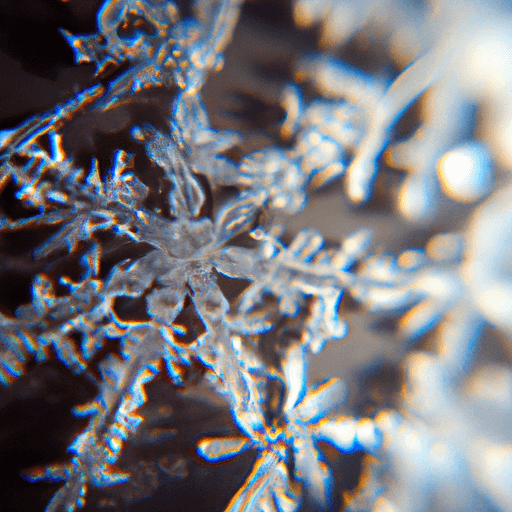
Can a shape have an edge that goes on forever but still fit inside a small space? A fractal called the Koch snowflake does exactly that. You start with a simple triangle and add smaller triangles to each side. Each new layer makes the edge longer but adds only a tiny bit of area.
You use geometry software to build the snowflake through many stages. Then you use power series (a way to add up shrinking numbers) to calculate the final area. The snowflake's area ends up only 1.6 times the original triangle.
You also try the same idea with a square shape. The square version produces a figure with an infinite edge but an area only 2.0 times the original square.
Hypothesis
The hypothesis is that it is possible to construct shapes with infinite perimeters but finite areas.
A power series adds numbers in a pattern — each term smaller than the last — to find a total that stays finite even as the series seems to go on forever. In the Koch snowflake experiment, you use geometry software to build the snowflake through many stages, adding smaller triangles to each side at every step. As a result, the edge grows without bound, yet each new layer contributes a shrinking amount of area. That means the series converges: the snowflake's area ends up only 1.6 times the original triangle.
A Koch snowflake grows by adding triangles to every side at each stage, which makes the edge longer but barely changes how much flat space the shape covers. After many stages, the snowflake's area ends up only 1.6 times the original triangle — finite, even as the edge grows without limit. You use power series to calculate this final area and prove that boundary length and covered surface can behave in completely different ways.
Method & Materials
You will use the Geometer's Sketchpad program and a Koch curve to construct a snowflake and calculate its area.
You will need the Geometer's Sketchpad program and a Koch curve.
MEL Math — hands-on math experiment kits delivered monthly — makes abstract concepts tangible. (Affiliate link)
This project reveals that it is possible to construct shapes with infinite perimeters but finite areas. Using the idea of convergent series, it is possible to add ever-smaller increments of area such that while the perimeter grows to infinity, the sum of the areas remains finite.
Why do this project?
This science project is unique because it explores the possibilities of fractals and power series to construct a snowflake and discover new families of curves with infinite perimeters and finite areas.
Also Consider
Experiment variations to consider include exploring the possibility of generalizing this approach to three dimensions, producing a shape of infinite surface area and finite volume, and constructing a snowflake with a different shape than the traditional triangular Koch curve.
Full project details
Additional information and source material for this project are available below.