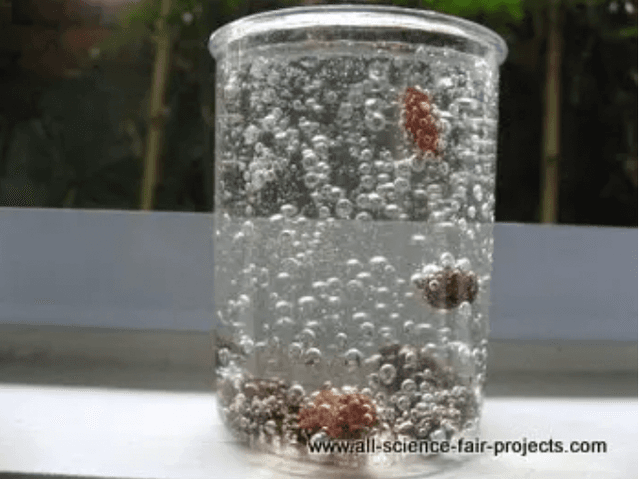
What happens when you drop raisins into a fizzy mix of vinegar and baking soda? The raisins sink at first. Then tiny gas bubbles form on their wrinkled surface and carry them up.
Once a raisin reaches the top, the bubbles pop. The raisin sinks again and the cycle repeats. You only need a glass jar, vinegar, baking soda, tap water, and a handful of raisins.
Watch the raisins rise and fall as long as the mixture keeps producing bubbles.
Hypothesis
The hypothesis is that the raisins will move around in the jar when vinegar and baking soda are added.
Vinegar and baking soda mix together in the jar and release carbon dioxide gas. That gas forms tiny bubbles on the wrinkled surface of each raisin and carries it upward. Once a raisin reaches the top, the bubbles pop and it sinks again — then the cycle repeats as long as the mixture keeps producing bubbles.
Density decides whether something floats or sinks. A raisin is denser than the liquid, so it sinks at first. Then tiny gas bubbles form on its wrinkled surface and cling there, making the raisin less dense overall. The bubbles act like tiny floats, carrying it upward. Once it reaches the top, the bubbles pop and the raisin becomes dense again — it sinks, and the cycle repeats.
When you drop raisins into a fizzy mix of vinegar and baking soda, they sink at first. Then tiny gas bubbles form on their wrinkled surface. As those bubbles collect, they carry each raisin upward. At the top, the bubbles pop and the raisin sinks again. The cycle repeats as long as the mixture keeps producing bubbles. All you need is a glass jar, vinegar, baking soda, tap water, and a handful of raisins.
Method & Materials
You will fill a jar with vinegar and water, add baking soda, and then drop in a few raisins.
You will need a large glass jar, vinegar, baking soda, and raisins.
The raisins will sink to the bottom of the jar when they are first dropped in, but then they will rise to the top and start to sink again. This is because the bubbles of carbon dioxide gas stick to the raisins and help carry them up to the surface.
Why do this project?
This science project is unique because it shows how a chemical reaction can cause an object to move.
Also Consider
Try this experiment with different types of acids and see if it works in the same way. You could also try using vinegar and baking soda to unclog sinks and drains.
Full project details
Additional information and source material for this project are available below.