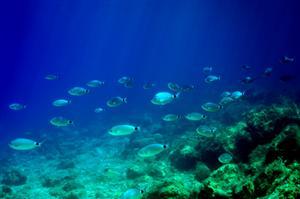
Do all colors disappear at the same depth underwater? A scuba diver carries red, yellow, green, and blue metal balls to four depths: 5, 10, 15, and 20 meters. At each depth, the diver photographs the balls with an underwater camera.
Water absorbs different wavelengths of light at different rates. Longer wavelengths like red fade first. Shorter wavelengths like blue travel deeper.
The photos show that red and yellow balls lose their visible color by 15 to 20 meters. Green and blue remain visible at all tested depths.
Hypothesis
The hypothesis is that the color of the red and yellow balls will reduce in intensity as the balls are submerged deeper into the water.
Water absorbs different wavelengths of light at different rates, so colors vanish at different depths. A scuba diver carries red, yellow, green, and blue metal balls to depths of 5, 10, 15, and 20 meters and photographs them at each level with an underwater camera. Longer wavelengths like red fade first. By 15 to 20 meters, the red and yellow balls have lost their visible color. Green and blue — with their shorter wavelengths — remain visible at all tested depths.
The full range of energy includes visible light, and water treats each part of that range differently. A scuba diver photographs red, yellow, green, and blue metal balls at four depths from 5 to 20 meters, revealing that water removes colors unevenly. The photos show that red and yellow balls lose their visible color by 15 to 20 meters, while green and blue remain visible at all tested depths.
Water takes in light energy at different rates for each wavelength. Longer wavelengths like red fade first as the water absorbs them quickly, while shorter wavelengths like blue travel deeper. A scuba diver carries red, yellow, green, and blue metal balls to depths of 5, 10, 15, and 20 meters and photographs them at each stop. The photos show that red and yellow balls lose their visible color by 15 to 20 meters, while green and blue remain visible at all tested depths.
Method & Materials
You will need to rent a boat and scuba diving gear, and hire an experienced diver. You will also need a high resolution underwater camera with flash, an underwater handheld flood light, and a depth gauge. Lastly, you will need colored metal balls - red, yellow, green and blue - and a black marker pen.
You will take a trip to the chosen diving location with the diver. Using the black marker pen, write the colors of the metal balls on its surface. The diver will take photographs of the metal balls at depths of 5 meters, 10 meters, 15 meters and 20 meters.
MEL Physics — hands-on physics experiment kits delivered monthly — real experiments, not just reading. (Affiliate link)
The results show that the color of the red and yellow balls cease to be visible at depths of 15 meters and 20 meters under water. This proves that the hypothesis is correct.
Why do this project?
This science project is interesting because it explores how the color of objects changes as they are submerged deeper into the water. It also shows how the wavelength of light affects the visibility of colors in water.
Also Consider
Consider repeating this project using balls of different colors such as violet, brown, white, orange and pink. Also, try to do the experiment in fresh water instead of sea water, or at night in the absence of any natural sunlight.
Full project details
Additional information and source material for this project are available below.