

Colored Glass Filters and Laser Power
Hard
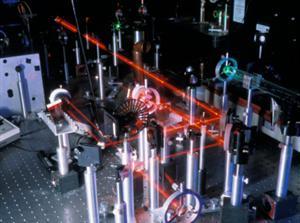
Can a colored glass filter reduce the power of a laser beam? You aim red, green, and blue laser pointers at a solar cell connected to a watt meter. Each laser is rated at 1 watt. First you measure the power without any filter.
Then you place red, green, and blue glass filters one at a time between each laser and the solar cell. You record the power reading for every combination.
The results show that none of the colored glass filters reduced laser power by a meaningful amount. The red laser delivered the most power overall. The blue laser delivered the least.
Hypothesis
The hypothesis is that the colored glass will filter and block the beam of the laser pointer.
Science Concepts Learned
Laser Light
Because a laser beam moves in one color and one direction, each photon carries the same wavelength of energy. When you aim red, green, and blue laser pointers at a solar cell, the red laser delivers the most power overall. Colored glass filters fail to block the beam significantly because the laser's single-wavelength light does not contain the mix of wavelengths that a broadband filter is designed to separate.
Method & Materials
You will need to set up a laser pointer, a holder for the laser pointer, colored glass filters, a watt-meter, and a solar cell. You will measure the power of the laser beam with the solar cell and record the results.
You will need a 1 watt red laser pointer, a 1 watt green laser pointer, a 1 watt blue laser pointer, a holder for the laser pointer, a red glass filter, a green glass filter, a blue glass filter, a watt-meter, a solar cell, and a 1-meter ruler.
MEL Physics — hands-on physics experiment kits delivered monthly — real experiments, not just reading. (Affiliate link)
See what’s includedResults
The results showed that the colored glass filters did not have any significant impact on the power of the laser beam. It was also observed that the red laser beam emitted the greatest amount of power and the blue beam, the least amount of power.
Why do this project?
This science project is interesting because it explores the power of lasers and colored filters. It also shows how the color of the laser beam affects the power of the beam.
Also Consider
Consider repeating the experiment with other color laser pointers like yellow or orange. You could also try passing the laser through a beaker filled with colored solution.
Full project details
Additional information and source material for this project are available below.Related videos
These videos explain the science behind this project and demonstrate key concepts used in the experiment.
Share this Science Project:
Browse by Grade
Related Science Fair Project Ideas
Photograph red, yellow, green, and blue balls at increasing ocean depths to discover which colors vanish first.
Hard
Build three speaker boxes of different depths and measure which frequencies each one boosts or cuts.
Hard
Freeze and heat a tuning fork from 0°C to 100°C and measure the subtle frequency shift that temperature creates.
Hard
Share this Science Project: