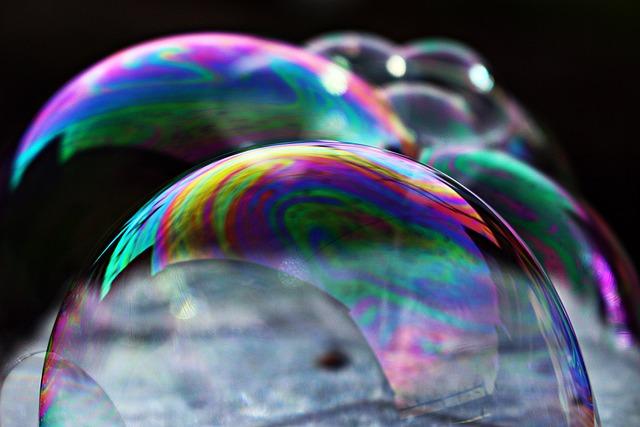
Can a soap bubble explode? Fill bubbles with hydrogen gas, light them on fire, and the answer depends entirely on their size.
This project uses a tank of hydrogen gas to blow soap bubbles of different sizes, from less than 1 mm to over 18 mm across. Each bubble is ignited with a lighter while you observe and compare the flames.
Bubbles smaller than 4 mm produce no flame at all. As size increases past that threshold, the flames grow larger. Above 18 mm, the combustion turns explosive.
Hypothesis
The hypothesis is that as the size of the hydrogen foam bubbles increase, the energy released in the combustion will be greater.
Hydrogen gas is so light that even a small amount trapped inside a soap bubble will lift and drift upward. This project fills soap bubbles with hydrogen gas from a tank, producing bubbles that range from less than 1 mm to over 18 mm across. Smaller bubbles hold so little of this lightweight gas that they produce no visible flame when ignited, while larger ones hold enough to combust visibly — and above 18 mm, combustion turns explosive.
The amount of fuel available determines how much heat and light a reaction releases. Hydrogen gas combines with oxygen when ignited, and the volume of gas trapped inside a soap bubble controls the intensity. Using a tank of hydrogen, you blow bubbles ranging from less than 1 mm to over 18 mm across and ignite each with a lighter. Bubbles smaller than 4 mm produce no visible flame at all. As size increases past that threshold the flames grow larger, and above 18 mm the combustion turns explosive.
Method & Materials
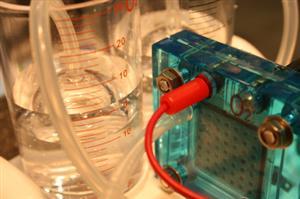
You will attach a lever to the hydrogen tank, fill a basin with liquid soap and water, and attach a tube to the lever. You will adjust the rate of hydrogen gas released into the soap mixture and vary the filters used to create bubbles of different sizes. You will then ignite the bubbles and observe the combustion that results.
You will need a tank of hydrogen gas, a flow control valve, tubing, a large basin, liquid soap, water, a lighter, a ruler, and various filters.
MEL Chemistry — hands-on chemistry experiment kits delivered monthly — great for building lab skills at home. (Affiliate link)
The results showed that no combustion took place for hydrogen foam bubbles that were less than 4mm in diameter. However, as the bubble size increased beyond 4 mm, combustion occurred, with increasingly larger flames as the bubble diameter increased. When the size of the bubbles were more than 18mm, the combustion became explosive.
Why do this project?
This science project is interesting because it explores the potential of using hydrogen as an alternative fuel source. It is unique because it looks at the effect of bubble size on the intensity of the combustion.
Also Consider
Experiment variations include using foam from a fire extinguisher and using the hydrogen foam bubbles to fuel a small rocket.
Full project details
Additional information and source material for this project are available below.