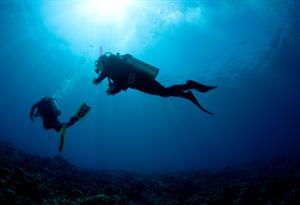
Does pollution in a lake change as you go deeper? A diver collects water samples from four depths: 1 meter, 2 meters, 3 meters, and 4 meters. Five samples are taken at each depth.
Back in the lab, you test every sample for four things:
- pH (acidity level)
- Turbidity (cloudiness)
- Ammonia content
- Nitrate content
Comparing the readings across depths shows whether pollutants concentrate near the surface or sink to the bottom.
Hypothesis
The hypothesis is that a water sample taken from deeper waters will contain less pollutant.
Gravity pulls heavier suspended particles downward over time, so cloudiness does not stay uniform from top to bottom in a lake. Near the surface, wind and waves keep fine sediment stirred up. Deeper water is calmer, letting particles settle — and a turbidity meter can capture exactly how much the readings shift as a diver descends from 1 meter down to 4 meters.
Ammonia forms when organic waste decomposes in water, and it can accumulate at different concentrations depending on depth. A diver collects water samples from four depths — 1 meter, 2 meters, 3 meters, and 4 meters — taking five samples at each level. Testing those samples for ammonia content alongside pH, turbidity, and nitrate reveals whether pollutants concentrate near the surface or sink as depth increases.
Method & Materials
You will need an experienced diver, diving gear, 20 empty bottles, pH paper, a turbidity meter, and a freshwater test kit. The diver will dive into the lake and obtain water samples from 4 different depths.
You will need a set of diving gear, an experienced diver, 20 empty bottles, pH paper, a turbidity meter, and a freshwater test kit.
Eureka Crate — engineering & invention kits for ages 12+ — monthly projects that build real-world skills. (Affiliate link)
The results of the tests showed that the levels of acidity, ammonia content and nitrate found in the water samples did not change significantly regardless of the depth at which these samples were obtained. However, the turbidity of the water increased as the depth of water increased.
Why do this project?
This science project is interesting because it shows how water pollution can vary with depth, and how it can affect the entire ecosystem.
Also Consider
Variations of this project could include testing water samples from rivers or oceans, or taking water samples from greater depths of 5 meters, 10 meters, 15 meters and 20 meters.
Full project details
Additional information and source material for this project are available below.