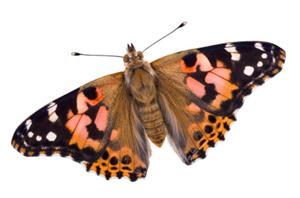
Does warmer air speed up a caterpillar's transformation into a butterfly? You raise Painted Lady caterpillars in three groups at different temperatures: 18°C, 24°C, and 30°C. Each group of twenty lives in a transparent tank with a leafy plant.
You watch the chrysalis (hard shell) stage each day. You record how many days each caterpillar takes to emerge as a butterfly.
The caterpillars kept at 30°C finish the fastest. The group at 18°C takes the longest to complete the change.
Hypothesis
The hypothesis is that the metamorphosis of the Painted Lady butterfly will occur more quickly at higher temperatures.
Because caterpillars rely on outside warmth to power their body's processes, warmer air accelerates their transformation. You can test this by raising Painted Lady caterpillars in three transparent tanks at 18°C, 24°C, and 30°C and watching the chrysalis stage each day. The caterpillars kept at 30°C finish the change the fastest. The group at 18°C takes the longest. Recording how many days each caterpillar takes to emerge as a butterfly shows how directly outside temperature controls the pace of metamorphosis.
Temperature controls how fast a caterpillar completes its transformation. Painted Lady caterpillars were raised in three groups at 18°C, 24°C, and 30°C — each group of twenty in a transparent tank with a leafy plant. The chrysalis (hard shell) stage was observed each day, and the group at 30°C finished the change fastest. As a result, the group at 18°C took the longest to emerge as butterflies.
Method & Materials
You will place caterpillars in three different tanks with different temperatures and observe how long it takes for them to transform into butterflies.
You will need three transparent fish tanks, sixty Painted Lady butterfly caterpillars, three leafy plants, an air conditioned room, an incandescent lamp, and three thermometers.
Tinker Crate — science & engineering build kits for ages 9–12 — real tools, real experiments, delivered monthly. (Affiliate link)
The results showed that the Painted Lady butterflies that were placed under the incandescent lamp at 30° C were the fastest to complete the transformation, followed by the butterflies in the tank under normal room conditions.
Why do this project?
This science project is interesting and unique because it allows us to observe the transformation of caterpillars into butterflies in just a few days.
Also Consider
Experiment variations to consider include placing the butterfly chrysalis inside a copper coil with magnetic fields, or repeating the experiment with mealworms to observe the metamorphosis of beetles.
Full project details
Additional information and source material for this project are available below.