

Hexagon Fractals from Paper Templates
Easy
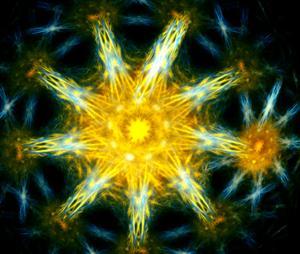
What happens when you repeat one simple shape at smaller and smaller sizes? A single hexagon looks ordinary. But nesting hexagons inside hexagons creates surprisingly complex patterns.
You cut six hexagon templates from cardboard. The sizes range from 160 mm down to 5 mm. You trace the largest hexagon on graph paper. Then you add smaller hexagons at each corner of the first one.
By the sixth round, a detailed design emerges from nothing but repeated hexagons. This process is called a fractal (a pattern that repeats itself at every scale).
Hypothesis
The hypothesis is that fractals can be used to make beautiful shapes and images.
Science Concepts Learned
Fractals
A fractal is a pattern that repeats itself at every scale. When you nest hexagons inside hexagons, that process becomes visible. You trace the largest hexagon on graph paper, then add smaller copies at each corner. As each round adds another layer of smaller hexagons, the design grows more complex. By the sixth round, a detailed pattern emerges from nothing but that one repeated shape.
Method & Materials
You will make a hexagon template, draw and cut out hexagons of different sizes, draw a hexagon in the center of the paper, draw hexagons on the corners of the hexagon, and add on the remaining sizes of hexagons.
You will need a large sheet of graph paper, a ruler, a paper cutter, a thick (1mm) cardboard A4 size, and a mechanical pencil.
MEL Math — hands-on math experiment kits delivered monthly — makes abstract concepts tangible. (Affiliate link)
See what’s includedResults
The results show that beautiful designs and creations that were previously unseen and unimaginable, can be created using fractals. The design in the experiment is one such example of fractals using the simple hexagon shape in only 6 stages.
Why do this project?
This science project is interesting and unique because it shows how complex and beautiful images can be created using simple mathematical formulae.
Also Consider
Experiment variations to consider include using other basic shapes like a square, circle or triangle of different sizes, and completing the research using a computer to simulate the growth of the fractals.
Full project details
Additional information and source material for this project are available below.Related video
These videos explain the science behind this project and demonstrate key concepts used in the experiment.
Share this Science Project:
Browse by Grade
Related Science Fair Project Ideas
Compare Big Mac prices across 10 countries and discover how a burger's cost relates to a nation's average income.
Easy

Set up a target across a room and calculate its exact distance using only angles measured from two points on a wall.
Medium

Drop a pencil in front of 100 to 500 people, record which hand catches it, and see if bigger groups give steadier results.
Medium
Share this Science Project: