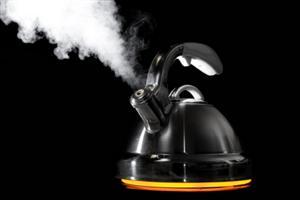
Does water always boil at 100°C? You test four different conditions to find out. You vary the water amount and heater type. You also change the room temperature and building floor level.
For each test, you boil water in a beaker and record the exact temperature. Most conditions give the same result. But on the 50th floor, the water boils at 99.5°C instead of 100°C.
The lower air pressure at higher floors is the only factor that changes the boiling point.
Hypothesis
The hypothesis is that water will come to boil more quickly at lower temperatures at higher altitudes.
Water turns into gas and forms bubbles at exactly 100°C — but only under normal conditions. You test four variables: water amount, heater type, room temperature, and building floor level. Most conditions give the same result. Only on the 50th floor does the reading change, dropping to 99.5°C. As a result, lower air pressure turns out to be the one factor that actually shifts the boiling point.
Air has weight, and that weight pushes down on everything — including the surface of liquids. At higher elevations, less air sits above you, so the air pushes down with less force. When you boil water in a beaker on the 50th floor, that reduced air weight is the only factor that shifts the boiling point, dropping it from 100°C to 99.5°C.
Method & Materials
You will use a hot plate, stove, thermometer, and beakers to measure the boiling point of water in different conditions.
You will need a high rise building, hot plate, stove, 8 beakers, 1800ml water, an air-conditioned room, and a thermometer.
MEL Physics — hands-on physics experiment kits delivered monthly — real experiments, not just reading. (Affiliate link)
The experiment showed that the boiling point of water was the same in all conditions except when it was boiled on the 50th floor of the building, where it boiled at 0.5°C lower.
Why do this project?
This science project is interesting because it shows how the boiling point of water can be affected by different conditions.
Also Consider
Experiment variations to consider include repeating the experiment on a rainy day and observing the effects of different concentrations of salt on the boiling temperature of water.
Full project details
Additional information and source material for this project are available below.