Does the smell of a predator slow a mouse down? Mice are natural prey for cats. You might expect them to freeze or panic at even a faint whiff of cat scent.
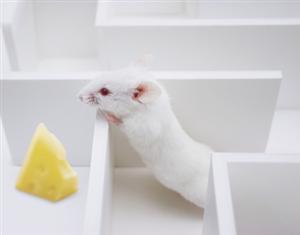
In this project, you train 10 mice to run a cardboard maze over nine days. On the tenth day, you place a cloth soaked in cat urine near the end of the maze. You then time each mouse and compare its speed to the day before.
The results may surprise you. The cat scent had almost no effect on how fast the mice finished the maze.
Hypothesis
The hypothesis is that the scent of a cat will cause a mouse to be slower in finding its food.
Animals can sense chemicals from predators, which might be expected to trigger fear or avoidance. Mice are natural prey for cats, so you might expect them to freeze or panic at even a faint whiff of cat scent. To test this, you train 10 mice to run a cardboard maze over nine days. On the tenth day, you place a cloth soaked in cat urine near the end of the maze and time each mouse. Compared to the day before, the cat scent had almost no effect on how fast the mice finished.
Prey animals do not always flee when they sense a predator nearby. Mice are natural prey for cats, yet a cloth soaked in cat urine placed near the end of a maze barely changed their speed. The cat scent had almost no effect on how fast the mice finished the maze.
Method & Materials
You will make a maze using cardboard, glue, and masking tape, and place a sunflower seed at the end. Then, you will drop the mice one at a time into the maze and time how long it takes them to find the food.
You will need 10 white mice, a packet of sunflower seed, cardboard or old carton boxes, scissors, masking tape, glue, a stopwatch, a meter-length ruler, and a cloth soaked in cat urine.
Eureka Crate — engineering & invention kits for ages 12+ — monthly projects that build real-world skills. (Affiliate link)
The results of the experiment showed that the smell of the cat's urine did not have any effect on how quickly the mice were able to complete the maze.
Why do this project?
This science project is interesting because it tests the traditional belief that cats can scare away mice.
Also Consider
To further explore this topic, it might be interesting to observe whether the sound of a cat (instead of its scent) will produce different results. Another variation could be to use wild mice instead of domesticated ones.
Full project details
Additional information and source material for this project are available below.