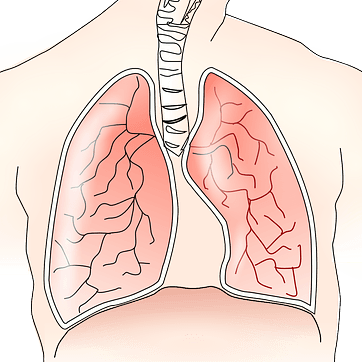
Do people who sing regularly have larger lung capacity than non-singers? You recruit 20 participants who are all the same age. Half are choir members with at least one year of experience. The other half are non-singers and non-athletes.
Each person takes one deep breath with a nose clip on. Then they blow as much air as possible into a balloon. You measure the balloon diameter with a ruler.
Choir members inflate their balloons to a larger size than non-singers. The results also show that boys tend to have greater lung capacity than girls.
Hypothesis
The hypothesis is that choir singers will have greater lung capacity than non-singers.
Lung capacity — the total air your lungs can hold in one deep breath — varies between people with different habits, and between boys and girls. You recruit 20 participants of the same age: half are choir members with at least one year of experience, the other half are non-singers and non-athletes. Each person puts on a nose clip, takes one deep breath, and blows as much air as possible into a balloon. You then measure the balloon diameter with a ruler. Choir members inflate their balloons to a larger size than non-singers, and the results also show that boys tend to have greater lung capacity than girls.
Regular vocal practice may strengthen the organs that bring air in and push it back out. To test this, you recruit 20 participants who are all the same age — half are choir members with at least one year of experience, the other half are non-singers and non-athletes. Each person takes one deep breath with a nose clip on, then blows as much air as possible into a balloon. You measure the balloon diameter with a ruler. Choir members inflate their balloons to a larger size than non-singers, suggesting that sustained breathing tasks like singing build lung capacity over time.
Method & Materials
You will measure the lung capacity of 10 singers and 10 non-singers by having them blow up balloons and measuring the size of the balloons.
You will need 5 boys and 5 girls age 15 who are in the school choir, 5 boys and 5 girls age 15 who are not in the school choir, 60 balloons, a ruler or measuring tape, and a nose plug or swimmer nose clip.
Eureka Crate — engineering & invention kits for ages 12+ — monthly projects that build real-world skills. (Affiliate link)
The results showed that the choir members were able to inflate the balloons to a larger size than the non-singers, indicating that the choir students had bigger lung capacities. It was also found that boys had a bigger lung capacity than girls.
Why do this project?
This science project is interesting because it shows how training can help strengthen our chest muscles and increase our lung capacity.
Also Consider
Variations: The experiment can be repeated by athletes instead of choir singers. Try to repeat the experiment using a spirometer instead of balloons to measure lung capacity.
Full project details
Additional information and source material for this project are available below.