What happens when you add ammonia to a salt solution that is growing crystals? Salt crystals form when water evaporates from a salty mixture. Adding certain chemicals can change how large those crystals get.
You prepare four bowls. The first holds salt and water. The second adds bluing liquid (a laundry product). The third adds bluing and three tablespoons of ammonia. The fourth adds bluing and six tablespoons of ammonia. You place a sponge in each bowl and let the crystals grow for ten days.
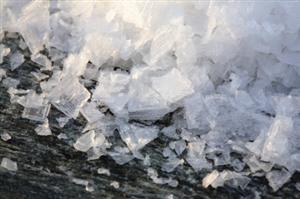
The bowls without ammonia grow small crystals about 2.5 mm tall. The bowl with the most ammonia grows crystals over 8 mm tall that overflow the bowl.
Hypothesis
The hypothesis is that when more ammonia is used, more salt crystals are formed.
Adding certain chemicals can change how large crystals get as particles stack together from a liquid into a solid. Here, the bowls without ammonia grow small crystals about 2.5 mm tall. The bowl with the most ammonia grows crystals over 8 mm tall that overflow the bowl.
When a mixture evaporates, the liquid turns to gas and moves into the air. Anything dissolved in that liquid stays behind as a solid. You prepare four bowls — each holds a different combination of salt, water, bluing liquid, and ammonia — and place a sponge in each one. As the water evaporates over ten days, the salt left behind forms crystals whose size depends on what was in the bowl.
Method & Materials
You will create four salt solutions with different ingredients, place a sponge in each bowl, and observe the size of the salt crystals that form.
You will need five bowls, four sponges, one packet of salt, one bottle of bluing liquid, one bottle of ammonia, one tablespoon, and one caliper.
MEL Chemistry — hands-on chemistry experiment kits delivered monthly — great for building lab skills at home. (Affiliate link)
The results showed that the solutions with only salt, water, and bluing had little crystallization, while the solutions with ammonia had more crystallization. The more ammonia added, the more crystallization occurred, with the solution with the most ammonia having the highest crystal height of 8.2mm.
Why do this project?
This science project is interesting because it explores how adding different ingredients to a salt solution can affect the size of the salt crystals.
Also Consider
Experiment variations include using sugar to form the crystals and using seawater.
Full project details
Additional information and source material for this project are available below.