Propeller Blade Size and Thrust
Hypothesis
Science Concepts Learned
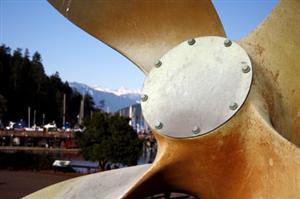
Propeller blades work by pushing air backward — the reaction force moves the vehicle forward. To test how blade size affects that push, you build three zinc sheet metal propellers in different sizes, each mounted on a 12V DC motor attached to a shoe box on wheels. Then you time how long the box takes to travel two meters. The largest propeller (30mm x 50mm) crosses the distance in 17 seconds, while the smallest (20mm x 30mm) takes 51 seconds. Bigger blades move more air with each spin and produce noticeably more thrust at the same motor speed.
Newton's Third Law explains why propeller blades generate thrust: the spinning blade pushes air backward, and the air pushes the vehicle forward with an equal and opposite force. Larger blades move more air per rotation, so the reaction force pushing forward is greater. The largest propeller moved the box in 17 seconds while the smallest took 51 seconds, showing that increasing the backward push on air directly increases the forward push on the vehicle.
A propeller's spinning blades push air backward, and the reaction force drives a vehicle forward. Larger blades move more air per rotation, generating greater thrust. This experiment demonstrates that relationship directly: a 30mm x 50mm propeller moves a shoe box in 17 seconds, while a 20mm x 30mm propeller takes 51 seconds at the same motor speed.
Method & Materials
Eureka Crate — engineering & invention kits for ages 12+ — monthly projects that build real-world skills. (Affiliate link)
See what’s includedResults
Why do this project?
Also Consider
Full project details
Additional information and source material for this project are available below.Related videos
Browse by Grade
Related Science Fair Project Ideas