Search for Science Fair Projects

1000 Science Fair Projects with Complete Instructions

Tire Pressure and Fuel Mileage

Tire Pressure and Fuel Mileage

Hard
Share this Science Project:
This page contains full project details. For the summary, please see the Project Summary.

Science Fair Project Description

We often read in road safety guides and magazines that we should always ensure that the tires on our cars are properly inflated with the correct amount of air pressure. Aside from affecting safety, under-inflated tires supposedly result in higher fuel consumption. This science fair project was conducted to determine if this is indeed true – ie: how does tire pressure affect the gasoline mileage of a car. The science fair project was carried out using 5 different types of cars and measuring the distance, a car with 100% and 80% of the recommended tire pressure, can travel with a gallon of gas.
Complexity level:7
Project cost ($):180
Time required:1 day to prepare, 1 day for observation
Material availability:Easily found
Safety concerns:

Hypothesis

Using the recommended tire pressure will provide bettergasoline mileage.

Overview

Tire pressure and gasoline mileage

Gas mileage refers to the number of miles a vehicle can travel on a gallon of gas. The gas mileage of a car can be affected by several factors such as the driver’s driving habits and tire pressure. Aggressive and high speed driving will normally result in a higher consumption of gasoline. The tire pressure of a car can also have a significant effect on the distance a car can travel on a gallon of gas. Inflating tires to the  recommended air pressure is said to be able to improve a car’s gasoline mileage by about 3%.

When the tire pressure is lower than the recommended value, the surface contact area between the tire and the road is greater. This will cause greater friction and more energy is required to move the car. As a result, more gasoline will be consumed. When the air pressure of a car’s tire is higher than the recommended value, the contact area between the tire and the road is reduced. It may improve the mileage but the safe-handling of the vehicle is reduced. A higher tire pressure also increases the risk of the tire exploding.

Scientific Terms

Gas mileage, tire pressure, friction

Materials

The materials required for this science fair project:

-    5 licensed and experienced drivers
-    5 cars of different models.
1.    A Toyota 1.5 liter
2.    A Honda 1.5 liter
3.    A Hyundai 1.5 liter
4.    A Chevrolet 1.6 liter
5.    A Nissan 1.6 liter

-    5 containers each containing 5 gallons of petrol
-    5 containers each containing 2.5 gallons of petrol
-    5 funnels
-    5 tire pressure gauges

Procedure

1.    For this science fair project, the independent variable is the type of car and tire pressure used – 100% and 80% of the recommended tire pressure. The dependent variable is the distance the car is able to travel on 5 gallons of petrol. This is determined by observing and recording the odometer readings in the car. The constants (control variables) are the amount and type of gasoline, the traffic on the highway, the car’s age and maintenance.

2.    5 drivers and 5 cars are used for this science fair project. The 5 types of cars used are a Toyota 1.5 liter, a Honda 1.5 liter, a Hyundai 1.5 liter, a Chevrolet 1.6 liter and a Nissan 1.6. Each driver is also given 2 empty containers, a tire pressure gauge and a funnel. The tire pressure of each type of car is adjusted to its recommended value.

3.    Plan a route for the cars to be driven. Choose a time to conduct the experiment when the roads along your route are not crowded (eg. a quiet weekend). The experiment is started by driving the cars around a gas station until the “Low Fuel” signal lights up. The drivers will then fill up exactly 5 gallons of petrol. Another 5 gallons  2.5 galloins of petrol will be filled into the 2 containers. Remember to have the drivers use exactly the same brand and type of petrol (eg. unleaded 92). The odometer on the dashboard is set to zero. Have the drivers inflate the tires on their cars to the recommended pressure (check the car manual).

4.    Have the drivers drive their respective cars at a constant speed of 50 miles per hour as far as possible, until the “Low Fuel” signal lights up again. The cars are stopped at the side of the road and the odometer readings recorded.

5.    The driver will release air from the car tires reducing the tire pressure to 80% of the recommended pressure. This is verified with the tire pressure gauge. Be careful not to release too much air. Using the funnel, another 5 gallons of petrol is poured into each car’s petrol tank. The odometers are again reset to zero.

6.    The drivers are then told to start the return journey and to stop their car when the “Low Fuel” signals light up. Again, ensure that they maintain a constant speed at 50 miles per hour, as much as possible, .The new odometer reading is taken when the low fuel indicator lights up. Using the funnel, top up the fuel tanks with the remaining 2.5 gallons of fuel and complete the return journey.

7.    The odometer readings are recorded in the table given below.
 

b1.jpg

Results

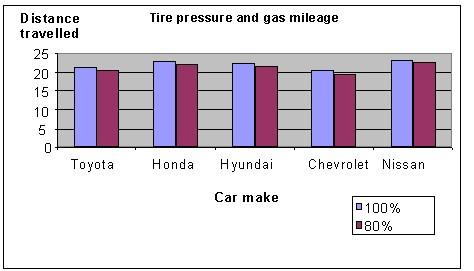
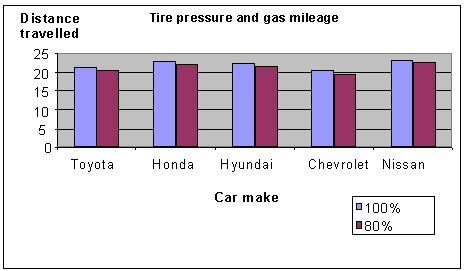
It is observed that the cars were able to travel about 2% to 4% further when the tire pressures were set at the recommended value compared to when the tires were set at 80% of the recommended value.
 

Tire pressure Distance travelled (miles)
  Toyota Honda Hyundai Chevrolet Nissan
100% pressure 132.9 141.6 139.1 126 146.1
80% pressure 128.5 137.8 134.1 120.8 141.2

The graph below represents the results of our science experiment.
car tire pressure science fair project

Conclusion

The hypothesis that inflating the tires on your car to the recommended tire pressure will provide a higher gasoline mileage is proven to be correct.

Increasing fuel prices has prompted drivers to identify more ways to improve the gas mileage of their cars. Many articles and websites provide  recommendations and suggestions on how to reduce gasoline consumption. One of the more popular recommendations is to have the car regularly checked and the recommended tire pressure maintained. This will not only improve the gas mileage by about 3%, but  will also reduce the wear and tear of the tire.
 

Also consider

What would happen if this science fair project were to be repeated using cars with different engine capacities?

Try to repeat the experiment using gasoline with different octane ratings, and different tires. What about the type of road surface? Would that affect the fuel efficiency of your car?
 

References

What is the ideal tire pressure - http://www.wisegeek.com/what-is-the-ideal-tire-pressure.htm 

Effect of tire pressure on gas mileage - http://www.ehow.com/facts_5871861_effect-tire-pressure-gas-mileage.html

How does tire pressure affect gas mileage - http://www.ehow.com/how-does_4683784_tire-pressure-affect-gas-mileage.html
 

Related videos

These videos explain the science behind this project and demonstrate key concepts used in the experiment.

Share this Science Project:

Related Science Fair Project Ideas

Rear Fog Lights and Distance Estimation
Park a car in artificial fog and test whether drivers stop closer to the correct distance when it has zero, one, or two rear fog lights.
Hard
Rush Hour Traffic and Vehicle Emissions
Record 18 hours of highway traffic on video and score each time window for speed, volume, and pollution potential.
Hard
Driving Speed and Fuel Economy
Give five cars the same fuel at 90 and 110 km/h to measure how much farther the slower speed goes.
Hard