Which type of barrier stops a tidal wave from reaching shore: a solid wall or a mangrove swamp? You build a wave simulator from a water tank and a plywood ramp. A 3-kilogram sandbag dropped down the ramp creates the wave.
You test three conditions: no barrier, a small clay wall, and a strip of artificial grass standing in for mangroves. After each drop, you measure how far the water travels across the plywood shore. The artificial mangrove swamp reduces wave travel the most, cutting the distance by more than half compared to no barrier.
Hypothesis
The hypothesis is that the artificial mangrove swamp will absorb the impact of tsunami waves better than the man-made barrier.
Wave energy is the power that moves through water, pushing everything in its path. A wave simulator shows this force in action. A sandbag dropped down a ramp sends a wave across a water tank, and you measure how far that energy pushes water across a plywood shore.
Keeping soil in place means slowing moving water before it carries material away. In this wave simulator, a strip of artificial grass stands in for mangroves and cuts wave travel by more than half. That result shows how tangled roots and stems absorb water energy — the same principle behind natural shore protection.
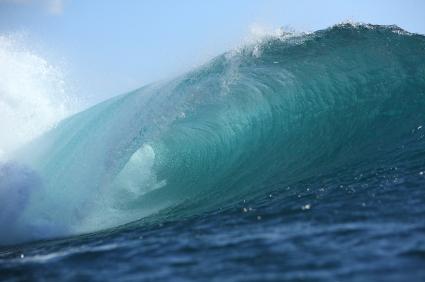
A tsunami forms when sudden movement of the sea floor pushes a huge wall of water toward shore. Barriers along the coast can reduce the damage. You can model this using a water tank and a plywood ramp. Then test whether a solid wall or a mangrove-style barrier blocks more wave energy.
Method & Materials
You will set up a tsunami simulator using a water tank, sand bag, and pieces of plywood. You will drop the sand bag from the ramp and measure how far the wave travels on shore.
You will need a water tank of dimensions 2 meters x 1 meter x 0.3 meter, a sand bag that weighs 3 kg, pieces of plywood of various dimensions, enough water to fill the tank, a box of clay or play dough, 10 bricks, a protractor and a ruler.
Eureka Crate — engineering & invention kits for ages 12+ — monthly projects that build real-world skills. (Affiliate link)
The results showed that the artificial grass (representing the mangrove swamp) absorbed the impact of tsunami waves more effectively than the man-made barrier. This suggests that mangrove swamps are very effective in stopping the onslaught of tsunami waves.
Why do this project?
This science project is interesting and unique because it tests the effectiveness of different barriers in stopping tsunamis. It also shows how mangrove swamps can be used to protect coastlines from the destructive power of tsunamis.
Also Consider
Consider using a larger water tank with a greater depth, and vary the gradient of the shore.
Full project details
Additional information and source material for this project are available below.