| Complexity level: | 4 |
| Project cost ($): | 30 |
| Time required: | 1 hour to prepare, 1 hour for experiment |
| Material availability: | Easily found. May be purchased at a supermarket/department store. |
| Safety concerns: |
Hypothesis
Soap bubbles will stay afloat longer in carbon dioxide than in air.
Overview
Floating soap bubbles
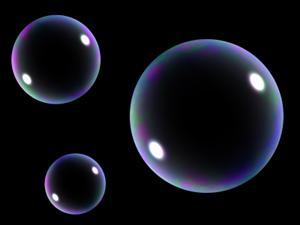
Soap bubbles have always been a source of entertainment for children. Even adults are fascinated by it. However, bubbles do not last very long and they either burst on their own or by upon collision with other bubbles. Soap bubbles are created by the surface tension of a fluid. Bubbles cannot be created by water alone - the mixture of soap in the water helps to stabilize the bubble.
The bubble is able to float in the air because it is very light. Except for the thin layer of fluid surrounding the sphere of the bubble, it contains only air. The slightest breeze would be enough to carry the bubble up into the air until it collides and bursts or the water simply dries up.
If the bubble is placed in an environment where the air is denser then the air inside the bubble, for example in a tank filled with carbon dioxide, the bubble should remain afloat in the air for a longer period of time. However if the opposite takes place where the surrounding air is less dense, like helium or hydrogen, the bubble should not remain afloat for long.
Scientific Terms
Materials
The materials required for this science fair project:
- 2 empty aquariums
- 100 grams of soap powder
- 1 liter of water
- bubble blowing toy
- small plastic container to mix the soap powder with water
- 200 ml of vinegar
- 100 ml of sodium bicarbonate
- 1 glass bowl
- 1 stopwatch
MEL Physics — hands-on physics experiment kits delivered monthly — real experiments, not just reading. (Affiliate link)
See what’s includedProcedure
1. For this experiment, the independent variable is the air density (amount of carbon dioxide) in the aquarium. The dependent variable is the length of time the soap bubble stays afloat. This is determined by recording the time using a stop watch. The constants (control variables) are the volume of the tank, the soap water mixture and the size of the bubbles.
2. The 2 water tanks are labeled as “carbon dioxide” and “air”. Both tanks are placed overturned on a flat table.
3. The 200 ml of vinegar and 100 ml of sodium bicarbonate is mixed in the glass bowl. The mixture will fizzle and produce carbon dioxide. The bowl is immediately placed under the tank labeled carbon dioxide until the chemical reaction stops. The tank labeled “carbon dioxide” is now filled with carbon dioxide.
4. The soap and water is mixed in the plastic container. Using the bubble blowing toy, practise blowing a few bubbles first.
5. Gently blow 5 bubbles into the tank labeled “carbon dioxide”. Record the time for all 5 bubbles to drop and touch the table surface. Repeat the test 5 times to obtain the average time. Record the readings in the table given below.
6. Similarly blow 5 bubbles into the tank labeled “air” and record the time for the bubbles to touch the table surface. Repeat the test 5 times and record the readings in the table below.
Results
The results show that the bubbles in the tank filled with carbon dioxide remain afloat for longer period of time, compared to the bubbles in the tank filled with regular air.
Tank content |
Time for the bubbles to drop (Seconds) |
Average (seconds) |
||||
1 |
2 |
3 |
4 |
5 |
||
Carbon dioxide |
35 |
38 |
34 |
35 |
33 |
35 |
Air |
15 |
12 |
13 |
14 |
16 |
14 |
Conclusion
The hypothesis that soap bubbles will stay afloat for a longer period of time in carbon dioxide than in air, is proven to be true.
Blowing soap bubbles is a form of entertainment for children, adults and yes, even animals. It is a very inexpensive way to spend quality time with kids. The soap bubble toy industry is also growing. Fancy battery operated devices are used to produce larger bubbles at a much faster rate. New soap formulae are also being created for the bubbles to last longer.
Also consider
Repeat the above experiment again and observe the changes in color, size and shape of the bubbles inside the tank.
Try to compare the results by repeating the experiment using helium gas instead of carbon dioxide.
Consider repeating this experiment by using dry ice placed in a large wok, to create a layer of carbon dioxide gas on top of which the bubbles will float.
References
Soap bubble - http://en.wikipedia.org/wiki/Soap_bubble
Soap bubble - http://scifun.chem.wisc.edu/HomeExpts/SOAPBUBL.html