Overview
Scientific Terms
Materials
Eureka Crate — engineering & invention kits for ages 12+ — monthly projects that build real-world skills. (Affiliate link)
See what’s includedProcedure
- Formulate your hypothesis: If an object is of a bright color, it will appear to travel (faster/slower) than its actual speed.
- Make two paper airplanes, one white and one red. Both airplanes should be folded the same way.
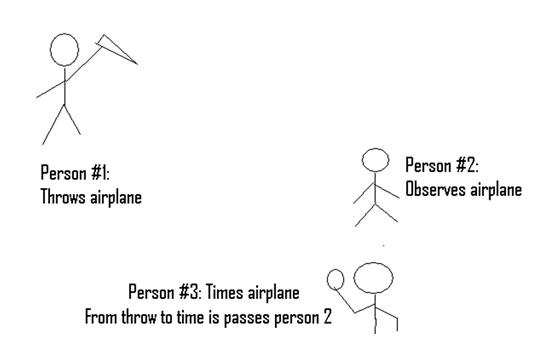
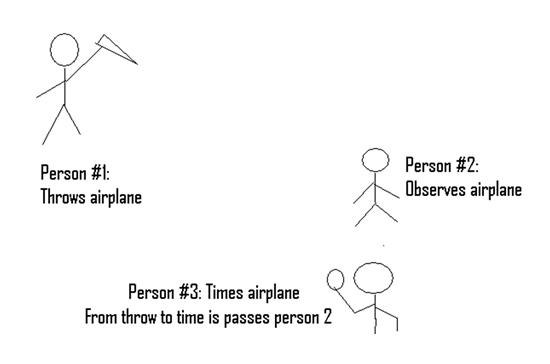
- Designate one person to throw the airplanes and the other person to observe the airplanes. You will be the time keeper.
- As the person timing the airplane, you will be standing behind the observer.
- Mark a spot on the floor for where the person throwing the airplane will stand and where the observer will stand. These two spots should be of a distance of at least 15 feet.
- The person throwing the airplanes should throw the air plane so that it flies past the observer. This person will first throw the white airplane.
- As the time keeper, you will start the stop watch when it leaves the hand of the person doing throwing and stop it when it passes by the observer.
- The time should be recorded in the data sheet.
- Ask the observer how long he or she thinks it took for the airplane to pass by them.
- Record this on the datasheet.
- Repeat these steps three times. After the three trials, change places with the observer.
- Repeat this experiment so that each person has a chance to play all three roles for a total of three trials.
- Record the information on the data sheet.
- Now compare the estimates of the observers to the actual time of the white air plane and red air plane.
- How accurate were the estimates?
- Was there a difference in estimates between the red plane and white plane?
- Was your hypothesis supported?
|
Color and Speed Data Sheet |
White plane |
Person #2 estimate of time |
Actual time |
Difference between estimated and actual time |
Red plane |
Person #2 estimate of time |
Actual time |
Difference between estimated and actual time |
|
Person #2 (first trial) |
||||||||
|
Person #2 (second trial) |
||||||||
|
Person #2 (third trial) |
||||||||
|
Person 2 (first trial) |
||||||||
|
Person 2 (second trial) |
||||||||
|
Person 2 (third trial) |
||||||||
|
Person 3 (first trial) |
||||||||
|
Person 3 (second trial) |
||||||||
|
Person 3 (third trial) |
References
Related videos
These videos explain the science behind this project and demonstrate key concepts used in the experiment.