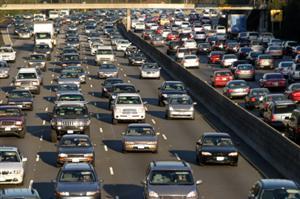
Does bumper-to-bumper traffic release more pollution than free-flowing traffic at the same spot? You set up a video camera above a 200-meter stretch of highway with a 90 km/h speed limit. You record 18 hours of traffic from 6 a.m. to midnight.
You then split the footage into six 3-hour windows. For each window, you measure average vehicle speed, traffic volume, and flow pattern. Peak commute hours show the highest pollution scores.
Hypothesis
The hypothesis is that air pollution will be the most severe in the early mornings and late evenings, during peak hour traffic.
Cars and traffic release harmful stuff into the air, and the amount changes throughout the day. This project sets up a video camera above a 200-meter stretch of highway with a 90 km/h speed limit, recording 18 hours of traffic from 6 a.m. to midnight. The footage splits into six 3-hour windows. For each window, you measure average vehicle speed, traffic volume, and flow pattern — and peak commute hours show the highest pollution scores.
Bumper-to-bumper traffic may release worse air pollution than free-flowing traffic at the same location. To test this, you position a video camera above a 200-meter stretch of highway with a 90 km/h speed limit and record 18 hours of traffic from 6 a.m. to midnight. The footage splits into six 3-hour windows, and for each you measure average vehicle speed, traffic volume, and flow pattern. Peak commute hours — early morning and late evening — produce the highest pollution scores, consistent with the hypothesis that exhaust emissions are most severe during rush hour.
Method & Materials
You will choose a raised location along a highway with a 90km/h speed limit. You will set up a video camera to capture an unobstructed view of a 200m stretch of the highway. You will divide the recording into 6 time windows of 3 hours each and observe the traffic speed, traffic volume, and traffic flow.
You will need a highway route with a speed limit of 90km/h, a video camera with a stand, a raised location to set the camera up and to view traffic, and a stopwatch.
Eureka Crate — engineering & invention kits for ages 12+ — monthly projects that build real-world skills. (Affiliate link)
The results show that pollution emitted by vehicles is the highest during peak hours - 6am to 9am, and 6pm to 9pm. This proves that the hypothesis is true.
Why do this project?
This science project is interesting because it shows how traffic flow affects the release of pollutant gases. It also shows how good driving habits and a well-maintained car can help reduce pollution emitted on roads.
Also Consider
Variations of this science project include repeating the experiment with diesel-operated vehicles, like busses and trucks, to test for differences in the levels of pollutants emitted. The experiment may also be repeated in other areas, like more urban or residential areas, to test for differences in the levels of pollutants emitted.
Full project details
Additional information and source material for this project are available below.