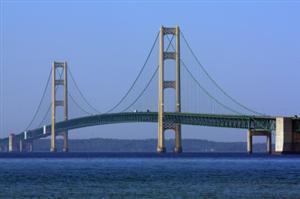
Does covering the sides of a bridge make it more likely to sway in the wind? You might expect a solid wall to add strength. In crosswinds, though, a flat surface acts like a sail and catches more force.
You build three model bridges from toothpicks and string. One has open sides. The second has sides half-covered with paper. The third has fully covered sides. You place each bridge one meter from an industrial fan and measure the tilt angle with a protractor.
The open-sided bridge tilts only 3 degrees. The half-covered bridge tilts 18 degrees. The fully covered bridge tilts 37 degrees. More side coverage means more wind catches the bridge.
Hypothesis
The hypothesis is that the bridge with minimal side-coverage will be the least affected by crosswinds.
Wind resistance grows when a surface shows more area to the air. A flat wall catches more push from the wind than an open frame. In one test, the open-sided bridge tilts only 3 degrees. The fully covered bridge tilts 37 degrees, showing more surface means more force from the wind.
A flat surface acts like a sail — and a fully covered bridge wall proves it. When you place three toothpick-and-string bridges one meter from an industrial fan, the open-sided bridge tilts only 3 degrees. The fully covered version, with paper walls catching the crosswind directly, tilts 37 degrees. More side coverage means more wind catches the structure and pushes harder on it.
Method & Materials
You will construct model bridges using toothpicks, chopsticks, clay, string, paper, scissors, glue, and protractors. Then, you will measure the angle of tilt of the bridge when exposed to wind from an industrial fan.
You will need 1500 toothpicks, 6 pairs of disposable chopsticks, a box of clay, 10 meters of string, letter-sized paper, a pair of scissors, 3 bottles of glue, 3 transparent protractors, and an industrial fan.
Tinker Crate — science & engineering build kits for ages 9–12 — real tools, real experiments, delivered monthly. (Affiliate link)
The results showed that the bridge with open sides had the least amount of tilt and swing caused by the wind from the fan. The bridge with 100% covered sides had the largest tilt angle.
Why do this project?
This science project is interesting because it allows students to explore how different bridge designs stand up to strong winds.
Also Consider
Experiment variations include building larger model bridges of different materials (e.g. aluminium, cast iron) to understand how the density and weight of the materials used to construct the bridge affects its ability to withstand high speed winds. Another variation is to repeat the experiment using varying wind speeds, or by simulating earthquakes.
Full project details
Additional information and source material for this project are available below.