

Surface Tension and Water Strider Design
Medium
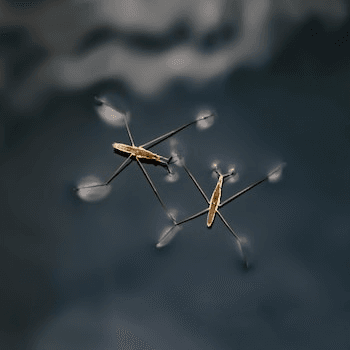
How do water striders walk on water without sinking? Their legs are water-repellent. They spread their weight across the surface tension (the thin stretchy layer on top of water).
You design and build your own model water strider from simple materials. Then you test whether it can stand on a bowl of water. If it sinks, you redesign and try again.
This engineering challenge teaches you how surface tension works by building something that depends on it.
Hypothesis
The hypothesis is that by using materials provided, you can engineer their own water strider that will float and walk on water.
Method & Materials
You can use a variety of materials to create your own water strider. Think about how bugs look in real life and what helps them float. Aluminum foil can be used to make all parts of the bug. Styrofoam can work well for feet and wire or pipe cleaners for legs, but it’s up to you to decide what to use. The goal is to create a water strider that can float on the water.
You will need wire, pipe cleaners, aluminum foil, straws, Styrofoam balls, markers, scissors, construction paper, tape, and water containers.
Tinker Crate — science & engineering build kits for ages 9–12 — real tools, real experiments, delivered monthly. (Affiliate link)
See what’s includedResults
In conclusion, the water strider experiment taught us that bugs can use their hydrophobic legs and the high surface tension of water to walk on water. One observation that stood out was the importance of increasing surface area to decrease pressure and help the water strider stay afloat.
Why do this project?
This science project is interesting because it challenges you to think about how nature works and use engineering to mimic the way bugs walk on water. It also teaches you about surface tension, hydrophobicity, and the engineering design process.
Also Consider
1) Try to get your water strider to float on different liquids or 2) Add soap to the water and watch what happens.
Full project details
Additional information and source material for this project are available below.Related videos
These videos explain the science behind this project and demonstrate key concepts used in the experiment.
Discover how water striders float and walk on water with this fun informative video from the Children's Museum of Houston. Learn about the science behind it and make your own water strider using different wires or bag ties!
Explore the fascinating science of surface tension and how it allows water striders to float and move swiftly on water's surface in the captivating slow-motion segments in this video from BBC Earth Lab!
Share this Science Project:
Browse by Grade
Related Science Fair Project Ideas
Design a protective case from household materials and find out whether your raw egg survives a high drop.
Medium
Build a working model elevator from thread reels and string that moves up and down when you turn a spool.
Medium

Build a Mariotte siphon from a 2-liter bottle and watch it deliver a constant flow rate regardless of water level.
Medium
Share this Science Project: