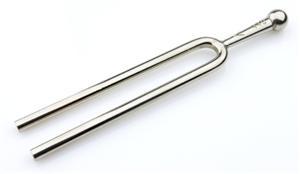
Does a hot tuning fork sound different from a cold one? You cool a 640 Hz tuning fork in a freezer and heat it in water on a stove to test five temperatures: 0°C, 25°C, 50°C, 75°C, and 100°C.
At each temperature you tap the fork and record its frequency (vibration speed) with a sound sensor and scope. An infrared thermometer confirms the temperature.
The fork's frequency drops slightly as it warms up. At 0°C it reads 641.6 Hz. At 100°C it drops to 639.9 Hz.
Hypothesis
The hypothesis is that the frequency of sound from a tuning fork will decrease as the temperature increases.
Precise measurement reveals just how slightly temperature shifts a vibration rate. You cool a 640 Hz tuning fork in a freezer and heat it in stages to test five temperatures: 0°C, 25°C, 50°C, 75°C, and 100°C. At each step you tap the fork and record its frequency with a sound sensor and scope. At 0°C it reads 641.6 Hz. By 100°C it drops to 639.9 Hz — a small but consistent change.
Some thermal changes are too subtle to notice without precise instruments. A 640 Hz tuning fork reads 641.6 Hz at 0°C, but as it warms the frequency edges downward. By 100°C it has dropped to 639.9 Hz — less than 2 Hz across the full range. At each temperature, an infrared thermometer confirms the reading while a sound sensor and scope capture the frequency. The result shows that even small temperature changes alter how the metal vibrates.
Method & Materials
You will vary the temperature of a tuning fork at 0°C, 25°C, 50°C, 75°C and 100°C, and measure the frequency of sound with a frequency sensor and scope.
You will need a tuning fork (640 Hz), a sound sensor and scope, a beaker, some water, a stove, a refrigerator, and an infrared thermometer.
MEL Physics — hands-on physics experiment kits delivered monthly — real experiments, not just reading. (Affiliate link)
The experiment showed that when the temperature of the tuning fork is increased, there is a slight reduction in the frequency sound generated. This proves that the hypothesis is true.
Why do this project?
This science project is interesting because it explores the relationship between temperature and sound, and how this affects the frequency of sound from a tuning fork.
Also Consider
Consider repeating the experiment with a tuning fork made from a different material, or with tuning forks of different frequencies.
Full project details
Additional information and source material for this project are available below.