

Sponge vs. Under-Gravel Aquarium Filters
Medium
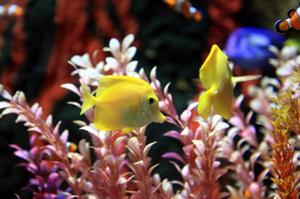
Can a sponge filter keep aquarium water cleaner than an under-gravel filter? Fish produce waste that raises ammonia and changes the water's pH. The right filter can slow that process down.
You set up two tanks with three goldfish each. One tank uses a sponge filter. The other uses an under-gravel filter. Each week for four weeks, you test the pH and ammonia levels.
By the end, you see which filter keeps the water closer to its starting condition.
Hypothesis
The hypothesis is that sponge aquarium filters are more effective than under-gravel filters.
Science Concepts Learned
Ammonia
Fish produce waste that breaks down into ammonia in aquarium water, and that buildup changes the water's pH over time. Two tanks each hold three goldfish — one uses a sponge filter, the other an under-gravel filter. Testing pH and ammonia levels weekly for four weeks shows which filter keeps the water closer to its starting condition.
Method & Materials
You will set up two aquariums with different types of filters, add three goldfish to each aquarium, and feed them the same amount of food each day. You will measure the pH and ammonia content of the water in each aquarium once a week for four weeks.
You will need six goldfish, two fish aquariums, fish food, water, a sponge filtration system, an under-gravel filtration system, and a freshwater test kit.
Tinker Crate — science & engineering build kits for ages 9–12 — real tools, real experiments, delivered monthly. (Affiliate link)
See what’s includedResults
The results showed that the sponge filtration system effectively maintained a lower pH value and also a lower ammonia content in the water, compared to the aquarium using the under-gravel filtration system.
Why do this project?
This science project is interesting because it shows how different types of aquarium filters can affect the water quality in the tank.
Also Consider
To improve the reliability and accuracy of the results, a larger sample of participants should be used. This science project can also be repeated with different types of filters like the power filter or canister filter.
Full project details
Additional information and source material for this project are available below.Related videos
These videos explain the science behind this project and demonstrate key concepts used in the experiment.
Share this Science Project:
Related Science Fair Project Ideas
Place guppies in five tanks at different acid levels and track survival every two hours to find the tipping point.
Medium
Add denitrifying bacteria to pond water and track whether nitrate levels drop faster than in untreated samples over three weeks.
Medium
Collect water from a boatyard, marina, beach, and tap, then send all four to a lab to compare heavy metal levels.
Medium
Share this Science Project: