

Sunshades and Car Cabin Temperature
Medium
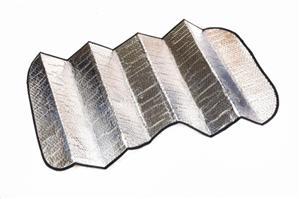
How much cooler does a car stay with a sunshade on the windshield? On a hot day, a dashboard can reach over 75 degrees Celsius without any shade.
You park three identical cars in the sun. One has no sunshade. One has a non-reflective sunshade. The third has a reflective sunshade. Every two hours, you check the temperature at three spots inside each car.
After 10 hours, you compare which setup kept the cabin coolest.
Hypothesis
The hypothesis is that cars with reflective sunshades have the lowest temperature inside the car.
Science Concepts Learned
Radiation
The sun sends energy as waves through space to surfaces below. On a hot day, a dashboard can reach over 75 degrees Celsius without any shade. You park three cars of the same make and model in the sun and measure the temperature inside over 10 hours.
Method & Materials
You will park three cars of the same make and model in the sun, one with no sunshade, one with a non-reflective sunshade, and one with a reflective sunshade. You will measure the temperature inside the cars over 10 hours using an infrared thermometer.
You will need three cars of the same make and model, one non-reflective sunshade, one reflective sunshade, and an infrared thermometer.
MEL Physics — hands-on physics experiment kits delivered monthly — real experiments, not just reading. (Affiliate link)
See what’s includedResults
The results showed that the car with the reflective sunshade had the lowest cabin temperature, followed by the car with the non-reflective sunshade. The car without a sunshade had a temperature that was higher than the other cars.
Why do this project?
This science project is interesting because it shows how reflective sunshades can make a big difference in the temperature inside a car.
Also Consider
Variations: What would happen if the experiment were to be repeated by using cars with tinted glass? The experiment can also be repeated by using cars with different colors and sunshades.
Full project details
Additional information and source material for this project are available below.Related videos
These videos explain the science behind this project and demonstrate key concepts used in the experiment.
Share this Science Project:
Related Science Fair Project Ideas

Drop food coloring into three jars of different temperature water and watch the color spread at wildly different speeds.
Medium
Burn equal pieces of oak, maple, cedar, and pine under water to discover which wood type produces the most heat.
Medium
Compare water in a wide plate versus a narrow glass, sun versus shade, and fan versus still air to see what speeds up evaporation.
Medium
Share this Science Project: