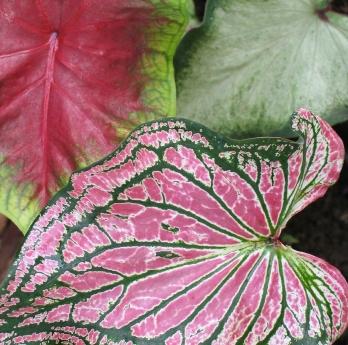
Do plants with bigger leaves lose more water? Plants release water through tiny pores called stomata on their leaf surfaces. Larger leaves might have more stomata and lose water faster.
You place three plants in beakers with 100 ml of water. One is ivy with small leaves. One is a money plant with medium leaves. One is an elephant ear with large leaves. A fourth beaker with no plant serves as the control. After five days, you measure how much water remains in each beaker.
The results may surprise you. Despite their different leaf sizes, the three plants lose similar amounts of water.
Hypothesis
The hypothesis is that plants with big leaves have more stomata and lose more water through transpiration.
Do plants with bigger leaves lose more water through their stomata? To test this, you place ivy, a money plant, and an elephant ear in separate beakers, each filled with 100 ml of water. A fourth beaker with no plant serves as the control. After five days, you measure how much water remains in each beaker. The results may surprise you: despite their very different leaf sizes, the three plants lose similar amounts of water. That means leaf size alone does not determine how much water a plant releases.
Leaf size may play a role in how much water a plant loses. Bigger leaves tend to have more stomata, and more stomata means more openings for water to escape through transpiration.
Method & Materials
You will need to get four beakers, a measuring cylinder, tap water, and three plants of similar size. Place the plants in the beakers and measure the water in each beaker after five days.
You will need four beakers, a measuring cylinder, tap water, and three plants of similar size.
Tinker Crate — science & engineering build kits for ages 9–12 — real tools, real experiments, delivered monthly. (Affiliate link)
After five days, the results showed that there was no significant difference in the amount of water lost from each of the beakers. This means that the hypothesis was proven to be false.
Why do this project?
This science project is interesting because it shows that the size of the leaves does not necessarily mean that more water is lost through transpiration.
Also Consider
Consider repeating the experiment using more varieties of plants, or by using just one plant variety but varying the number of leaves. You could also repeat the experiment by calculating the surface area of the leaves and comparing the difference in results.
Full project details
Additional information and source material for this project are available below.