

Cycling vs. Running on Hill Slopes
Hard
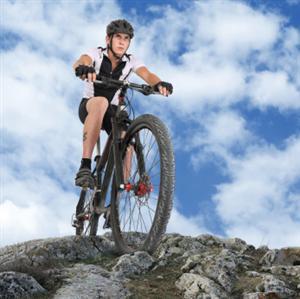
At what slope angle do runners start to beat cyclists? On flat ground, a bicycle covers distance much faster than running. But steep hills change the balance.
Ten runners and ten cyclists each race 50-meter courses. The slopes range from flat ground up to a steep 40° incline. A stopwatch records the time for each attempt. The average times are compared.
Cyclists win on flatter slopes. Runners win on steeper ones. The crossover point is near 30°, where both groups finish in almost the same time.
Hypothesis
The hypothesis is that as the inclination of the hill increases, a cyclist will be slower than a runner.
Method & Materials
You will choose 10 amateur cyclists and 10 amateur runners to take part in the experiment. You will also choose four hills with different inclines and measure the inclines with an inclinometer. The distance of each course is 50 meters and you will mark the starting and finish lines with white chalk. The time taken by the 10 participants at each course will be measured with a stopwatch and the average time will be recorded.
You will need 10 amateur cyclists, 10 amateur runners, 1 bicycle, 1 inclinometer, 1 flat road, 4 hill roads at different inclinations, 1 stopwatch, 1 box of white chalk, a 100m long measurement tape, and an assistant.
Eureka Crate — engineering & invention kits for ages 12+ — monthly projects that build real-world skills. (Affiliate link)
See what’s includedResults
The results showed that at the slope of 30°, the runners and the cyclists were at almost the same speed. The cyclists were faster at slopes below 30° gradient but the runners were faster at slopes above 30°.
Why do this project?
This science project is interesting because it shows how different inclines can affect the speed of cyclists and runners. It also shows how experience and training can help cyclists climb hills quickly and efficiently.
Also Consider
Try repeating the experiment using a mountain bicycle. You can also repeat the experiment with a 2km or 5km hill course with cyclists and long distance runners.
Full project details
Additional information and source material for this project are available below.Related videos
These videos explain the science behind this project and demonstrate key concepts used in the experiment.
Share this Science Project:
Browse by Grade
Related Science Fair Project Ideas
Time swimmers racing 100 meters with and without caps to find out whether a swimming cap actually makes a speed difference.
Hard

Have the same batters hit baseballs indoors and outdoors to find out whether the stadium type changes their distance.
Hard

Count how many times a tennis ball bounces in one minute on clay, grass, and asphalt to find the fastest court surface.
Hard
Share this Science Project: