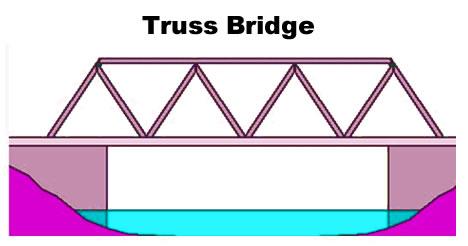
Which shape holds more weight in a bridge: a triangle or a square? Bridges use basic geometric shapes to carry heavy loads. You build two small bridges from toothpicks and glue to test which shape is stronger.
First you make 18 triangles and 10 squares from toothpicks. After drying you connect the triangles into a truss (a repeating frame). You build a second truss from the squares. Then you place a bucket on top and add scoops of gravel. You count how many scoops it takes before the bridge collapses.
Hypothesis
The hypothesis is that if a bridge is built with triangle-shaped supports, then it will be stronger and hold more weight than a bridge built with square-shaped supports.
Bridges rely on basic geometric shapes to carry heavy loads, and not all shapes perform equally. You build two toothpick trusses — one from triangles, one from squares — then set a bucket on top and add scoops of gravel one at a time. The number of scoops each truss holds before it collapses reveals which shape makes the stronger frame.
Which shape holds more weight in a bridge: a triangle or a square? Bridges use basic geometric shapes to carry heavy loads, and the shape of each support makes a real difference. To test this, you build two small bridges from toothpicks and glue — one truss made from triangles, one from squares. You load a small bucket on top and add scoops of gravel until the bridge collapses. Counting the scoops tells you exactly which shape is stronger.
A truss is a repeating frame built from triangles. In this experiment, you make 18 toothpick triangles and connect them into that frame. When you set a bucket on top and add scoops of gravel, you find out how much weight the triangle frame holds before it collapses.
Method & Materials
You will make triangles and squares out of toothpicks and glue, then build two trusses with them. You will then connect the trusses to form a bridge and test how much weight it can hold.
You will need a box of flat toothpicks, craft glue, wood glue or Elmer's glue, cardboard, waxed paper, paper towels, a small bucket, and rock material such as gravel, pebbles, or sand.
Tinker Crate — science & engineering build kits for ages 9–12 — real tools, real experiments, delivered monthly. (Affiliate link)
After testing the bridges, it was found that the bridge with triangle-shaped supports was able to hold more weight than the bridge with square-shaped supports. This shows that triangles are stronger than squares when it comes to distributing force.
Why do this project?
This science project is interesting because it shows how geometry can be used to build strong structures. It also shows how triangles are better than squares when it comes to distributing force.
Also Consider
Variations of this project could include testing different shapes, such as hexagons, or testing different materials, such as popsicle sticks.
Full project details
Additional information and source material for this project are available below.