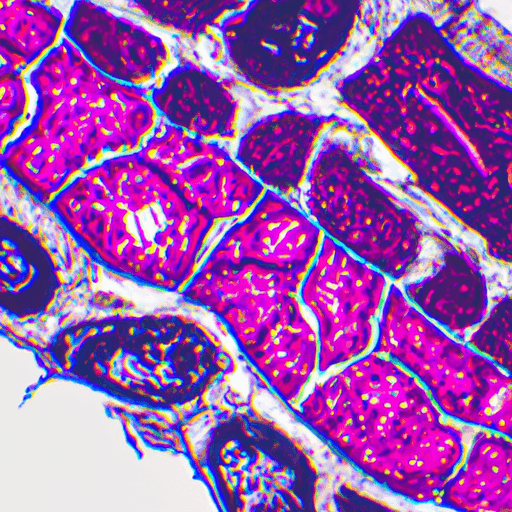
Does a larger organism have larger cells? You might expect a big animal to have bigger building blocks than a tiny plant. But cells do not always scale with body size.
You measure cells from different organisms under a microscope. Human cheek cells average about 70 microns. Human vein cells average about 47 microns. Spinal cord cells come in near 57 microns.
Then you measure cells from two plants. Elodea (a common water plant) has cells averaging 242 microns. Wild algae cells average 174 microns. The smallest organism in the group has the largest cells. Body size does not predict cell size.
Hypothesis
The hypothesis is that the size of an organism is related to the size of the cells that make it up.
A larger organism does not necessarily have larger cells — and measuring specimens under a microscope makes that clear. Human cheek cells average about 70 microns, human vein cells about 47 microns, and spinal cord cells come in near 57 microns. Then consider the plants: Elodea, a common water plant, has cells averaging 242 microns, and wild algae cells average 174 microns. That means the smallest organism in the group has the largest cells. Body size simply does not predict cell size.
A microscope's lenses reveal details far too small for your eyes alone — including the actual size of individual cells. When you measure cells from different organisms under a microscope, the numbers are surprising. Human cheek cells average about 70 microns, while Elodea, a small water plant, has cells averaging 242 microns. That means the smallest organism in the group has the largest cells. No unaided eye can detect objects measured in microns, so without microscopy this finding would be invisible — and the assumption that body size predicts cell size would go unchallenged.
Method & Materials
You will measure the length of cells from different organisms under a microscope and measure the size of the different organisms.
You will need a microscope, a ruler, and specimens of different organisms.
Eureka Crate — engineering & invention kits for ages 12+ — monthly projects that build real-world skills. (Affiliate link)
Our results showed that there is no absolute relation between the size of an organism and the size of the cells that constitute it. For example, the average cell size of elodea was larger than that of humans.
Why do this project?
This science project is interesting because it explores the relationship between the size of an organism and the size of the cells that make it up.
Also Consider
Experiment variations to consider include measuring the width of the cells and measuring the size of the organisms in different ways.
Full project details
Additional information and source material for this project are available below.