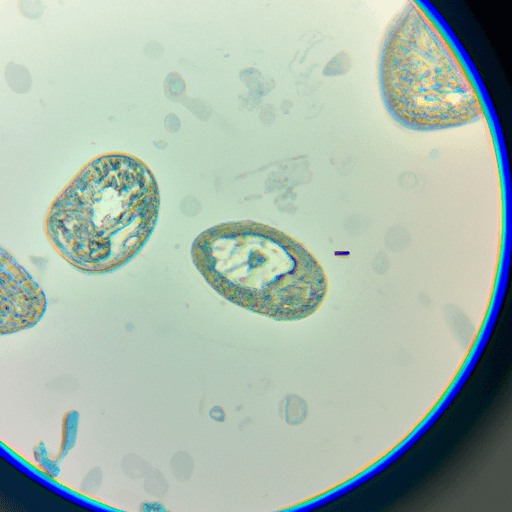
What happens to a living cell when you drop a salt crystal next to it? You place a culture of living organisms on a microscope slide and watch their normal movement. Then you introduce different substances one at a time: salt, vinegar, caffeinated coffee, decaffeinated coffee, sugar, and cotton fibers.
After each addition, you observe how the cells respond. Some may speed up. Others may stop moving entirely. New structures may become visible on the organism.
This project reveals how cells react to both mechanical and chemical changes in their environment. It also shows the streaming of protoplasm (the flowing movement inside living cells).
Hypothesis
The hypothesis is that living cells will respond differently to different stimuli.
Sensing a change and reacting to it happens even inside a single living cell. You place a culture of living organisms on a microscope slide and watch their normal movement. Then you introduce different substances one at a time — salt, vinegar, caffeinated coffee, decaffeinated coffee, sugar, and cotton fibers. After each addition, the cells respond in distinct ways. Some may speed up. Others may stop moving entirely. New structures may become visible on the organism. That range of reactions reveals how cells respond to both mechanical and chemical changes in their environment.
Living cells are not static — they move food and waste through a process called protoplasmic streaming, the flowing movement inside living cells. You can observe this directly by placing a culture of living organisms on a microscope slide and watching their normal movement. Then you introduce different substances one at a time: salt crystals, vinegar, caffeinated coffee, decaffeinated coffee, sugar, and cotton fibers. After each addition, check how the cells respond. Some may speed up. Others may stop moving entirely. New structures may even become visible on the organism. The experiment reveals how cells react to both mechanical and chemical changes in their environment — and how that internal flow shifts in response.
Method & Materials
You will observe the reaction of living cells to mechanical and chemical stimuli, observe the streaming of protoplasma in living cells, and identify the relationship between cell response and survival.
You will need a living culture, a compound microscope, droppers, salt crystals, vinegar, microscope slides and coverslips, decaffeinated and caffeinated coffee, sugar, and cotton fibers.
Eureka Crate — engineering & invention kits for ages 12+ — monthly projects that build real-world skills. (Affiliate link)
We've observed how living cells respond to different stimuli, and it's clear that their response is essential for their survival. We've seen how they move and change when exposed to different substances.
Why do this project?
This science project is interesting and unique because it allows us to observe the behavior of living cells in response to different stimuli.
Also Consider
Experiment variations to consider include observing the response of living cells to different temperatures or to different concentrations of the same stimuli.
Full project details
Additional information and source material for this project are available below.