Does a simple number game hold a hidden link to shapes in higher dimensions? The game of Nim uses binary addition without carrying. The numbers in this system are called Nimbers.
You prove that Nimbers form an Abelian group (a set where addition follows certain rules). Then you map each Nimber to a point on a Simplex (a shape like a triangle or pyramid extended into more dimensions). You build a 3D Simplex model to see this mapping in action.
The mapping turns out to be one-to-one. Each Nimber matches exactly one point in multi-dimensional space. You can even use the Simplex graph to perform Nim addition visually.
Hypothesis
The hypothesis is that there is a mapping between Nimbers (non-negative integers under Nim addition) and Simplexes.
Binary numbers use only two digits, zero and one, to represent any value. In this number-game project, you show how values can be counted using their base 2 representations, putting binary counting to work in a real proof.
Group theory studies how actions can be combined and reversed in patterns. Here, the actions are Nim additions — binary addition without carrying — and you prove that Nimbers (non-negative integers under this operation) form an Abelian group, a set where addition follows certain rules. When each Nimber maps to a point on a Simplex (a triangle or pyramid extended into more dimensions), the mapping turns out to be one-to-one: each Nimber matches exactly one point in multi-dimensional space. You build a 3D Simplex model using Zometool to see this in action and even use the Simplex graph to perform Nim addition visually.
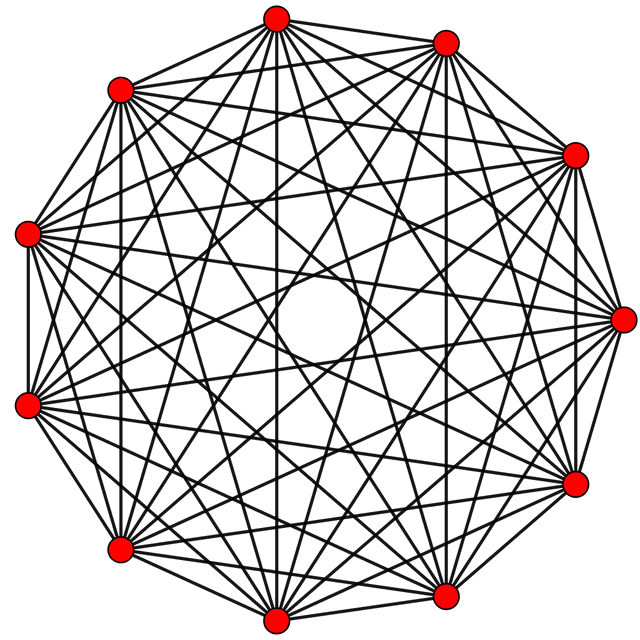
A simplex is the simplest shape in any number of dimensions — a point, a line segment, a triangle, or a pyramid. Each simplex has a specific number of vertices, edges, and faces that follow a pattern as dimensions increase. In this project, you construct a Simplex-3 using Zometool to see how these shapes look in three-dimensional space.
A mathematical proof builds a step-by-step argument showing why a statement must always be true — not just sometimes. In this experiment, you prove that Nimbers form an Abelian group, a set where addition follows certain rules. As a result, you also find a one-to-one mapping between Nimbers and points on a Simplex, meaning each Nimber matches exactly one point in multi-dimensional space.
Combinatorial game theory studies turn-based games where both players see all the pieces and no luck is involved — and Nim is one of its clearest examples. The game runs on binary addition without carrying, producing a number system called Nimbers. This project begins by proving that Nimbers form an Abelian group: a set where addition follows specific structural rules. From there, you map each Nimber to a point on a Simplex, a shape like a triangle or pyramid extended into more dimensions. The mapping turns out to be one-to-one, meaning each Nimber matches exactly one point in multi-dimensional space. You can even build a 3D Simplex model and use the graph to perform Nim addition visually.
Method & Materials
You will research the game of Nim, Nimbers, Nim addition, group properties, and the winning strategy for Nim. You will also research Simplexes and their properties. You will prove that Nim addition has the properties of an Abelian group and show how Nimbers can be counted with their base 2 representations. You will determine a way to find the number of vertices, edges, and faces in a Simplex and prove that there is a one-to-one mapping between Nimbers and Simplexes. You will explore properties of this mapping to show how a Simplex could be used for Nim addition and how Nimbers determine their own unique Abelian groups and are locations in multidimensional space. You will construct a Simplex-3 using Zometool to illustrate this mapping.
You will need Zometool, a Dell PC running Microsoft Windows 98 and Word 97, and an HP printer.
MEL Math — hands-on math experiment kits delivered monthly — makes abstract concepts tangible. (Affiliate link)
This project has demonstrated that Nim addition has the 5 Abelian group properties and that Nimbers can be graphed onto Simplexes for lines, triangles, and tetrahedrons. It has also been proven that there is a one-to-one mapping between Nimbers and Simplexes, and that Nimbers determine their own unique Abelian groups and are locations in multidimensional space.
Why do this project?
This project is so interesting and unique because it shows how finite groups can relate very different mathematical objects to each other.
Also Consider
Experiment variations to consider include exploring the properties of the mapping between Nimbers and Simplexes in more detail, and constructing a Simplex-4 to illustrate the mapping.
Full project details
Additional information and source material for this project are available below.