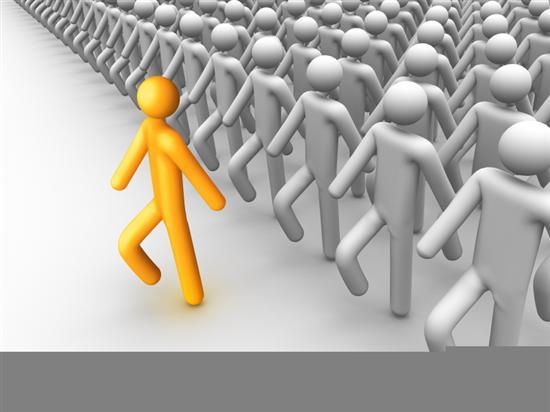
Can a room full of wrong answers push you to give the same wrong answer? You set up a group of 10 people who are secretly told to choose an obviously incorrect response on purpose. One real participant joins them without knowing.
The group is shown simple shapes and asked to match two that are the same size. The planted members all pick the wrong pair first. Then the real participant answers.
A second question reverses the order so the participant answers before anyone else. You repeat this with 20 male and 20 female participants and compare how often each gender follows the crowd.
Hypothesis
The hypothesis is that male participants are more affected by peer pressure than female participants.
Whether boys and girls respond differently to peer pressure is a social behavior question as much as a scientific one. You set up a group of 10 people secretly told to choose an obviously incorrect response — then one real participant joins without knowing the plan. The group is shown simple shapes and asked to match two that are the same size. The planted members all pick the wrong pair first, putting pressure on the participant who answers next. Running this with 20 male and 20 female participants, then comparing how often each group follows the crowd, reveals whether peer influence shapes choices differently by gender.
A shape-matching task can reveal just how strong the push to follow the crowd really is. Ten planted members all pick the wrong pair on purpose — then one real participant, unaware of the setup, answers the same question. A second question reverses the order so the participant answers before anyone else, giving a baseline free from group influence. Running this with 20 male and 20 female participants makes it possible to compare how often each gender goes along with a room full of wrong answers.
When the group speaks first, conformity grows stronger. In this experiment, ten planted members all pick the wrong pair first — matching two obviously incorrect shapes — before the real participant answers. That order matters. You then reverse it on a second question so the participant answers before anyone else, letting you measure how much the prior group pressure shaped their response. Running this with 20 male and 20 female participants shows whether gender affects how often someone follows the crowd.
Method & Materials
You will select 25 male and 25 female students, and have 10 of them give wrong answers to two questions. The remaining participants will then answer the questions, and you will compare the results.
You will need 25 male students, 25 female students, a whiteboard, a classroom, and a black marker pen.
Eureka Crate — engineering & invention kits for ages 12+ — monthly projects that build real-world skills. (Affiliate link)
The results showed that the male participants were more likely to give the wrong answer when their peers did, compared to the female participants. This supports the hypothesis that male participants are more affected by peer pressure than female participants.
Why do this project?
This science project is interesting because it looks at how gender affects how people respond to peer pressure, which is something that many people experience in their daily lives.
Also Consider
Consider repeating the experiment to compare the effects of peer pressure among different age groups, or conduct a survey to see how peer pressure affects people's habits and behavior.
Full project details
Additional information and source material for this project are available below.