

Disinfectant Concentration and Bacteria Resistance
Hard
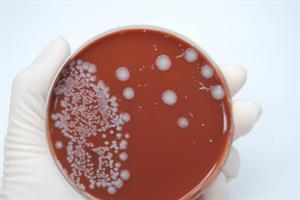
Can bacteria develop resistance to disinfectant over several generations? The Kirby-Bauer disk method measures how well an antimicrobial agent stops bacteria from growing. A larger clear zone around the disk means stronger killing power.
You grow E. coli on agar plates with filter paper disks soaked in 25%, 50%, and 75% Dettol disinfectant. After two days, you measure the inhibition zone (the bacteria-free ring around each disk). Then you collect surviving bacteria from the edge and use them to start the next generation. You repeat this for four generations.
Higher concentrations produce larger inhibition zones. However, zone sizes stay stable across all four generations, showing no sign of increasing resistance.
Hypothesis
The hypothesis is that lower disinfectant concentrations cause the bacteria to develop resistance more quickly.
Method & Materials
You will prepare 12 Petri dishes of agar, mix different concentrations of dettol disinfectant with water, and rub a swab of bacteria culture all over the agar surface of the Petri dishes. You will then place filter paper discs in the middle of the Petri dishes and observe the results after two days.
You will need 12 agar Petri dishes, 12 disinfected swabs, a bottle of disinfected water, a filter paper, a hole puncher, 4 test tubes, a measuring cylinder, a bottle of dettol disinfectant, a beaker of water, E. Coli bacteria culture, a pair of sterile forceps, and a marker pen.
Eureka Crate — engineering & invention kits for ages 12+ — monthly projects that build real-world skills. (Affiliate link)
See what’s includedResults
The results show that a higher concentration of dettol disinfectant result in a larger inhibition zone. However, there is no significant change in the relative sizes of the inhibition zones after 4 generations, indicating no change in bacteria resistance.
Why do this project?
This science project is interesting because it explores the effects of different concentrations of disinfectant on bacteria growth. It also demonstrates the concept of the Kirby-Bauer disk diffusion method, which is used by microbiologists to assess the effectiveness of antimicrobial agents.
Also Consider
Variations of this experiment include testing the resistance of various other kinds of bacteria, and using different types of disinfectants such as antibacterial soaps, Listerine or bleach.
Full project details
Additional information and source material for this project are available below.Related videos
These videos explain the science behind this project and demonstrate key concepts used in the experiment.
Share this Science Project:
Browse by Grade
Related Science Fair Project Ideas
Grow bacteria from four differently washed chopsticks on blood agar and find out how long antibacterial soap really needs to work.
Hard
Add garlic extract to E. coli in a petri dish and track whether the bacteria can grow at all over five days.
Hard

Open three types of baby food, leave them out for different lengths of time, and measure which one grows the most bacteria.
Hard
Share this Science Project: