Search for Science Fair Projects

1000 Science Fair Projects with Complete Instructions

General Chemistry Science Fair Project

Voltage and Electrolysis Speed
Medium
Voltage and Electrolysis Speed | Science Fair Projects | STEM Projects
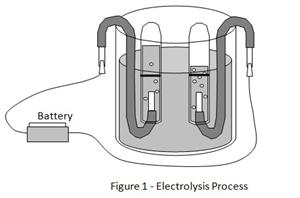
Does higher voltage make electrolysis happen faster? You set up a beaker of salt water with two copper electrodes and connect them to batteries. As current flows, hydrogen gas bubbles collect inside an inverted test tube. You start with a single 1.5V battery and time how long it takes to fill the tube to a marked line. Then you repeat with 2, 3, and 4 batteries. More voltage pushes more current through the solution. The hydrogen gas collects faster each time you add another battery.

Hypothesis

The hypothesis is that increasing the DC voltage applied to an electrolyte solution will increase the rate of release of hydrogen gas.

Science Concepts Learned

Electrolysis

Electrolysis uses electricity to break water apart, and more batteries mean faster results. More voltage pushes more current through the solution, so the hydrogen gas collects faster each time you add another battery.

Hydrogen Gas

Running electricity through salt water splits the water apart, and the hydrogen gas that forms is visible as bubbles collecting on the copper electrodes. Two copper wires sit in a beaker of salt water and connect to batteries. As current flows, hydrogen gas rises into an inverted test tube placed over one wire. More voltage pushes more current through the solution, so the gas collects faster each time you add another battery.

Method & Materials

You will need to strip the insulation of two copper wires, fill a beaker with water and salt, draw a line on two test tubes, and connect the battery terminals to the copper wires.
You will need a beaker, tap water, salt, four 1.5V batteries, a battery holder, two jumper wires, two test tubes, two PVC insulated copper wires, a stop watch, a pair of pliers, and a black color permanent marker pen.

MEL Chemistryhands-on chemistry experiment kits delivered monthly — great for building lab skills at home. (Affiliate link)

See whats included

Results

Our hypothesis was proven to be true. Increasing the DC voltage applied to the electrolyte solution sped up the release of hydrogen gas. We observed that the time taken to collect the released hydrogen gas decreased as the voltage increased.

Why do this project?

This science project is interesting because it explores the effects of increasing voltage on electrolysis. It also shows how electrolysis can be used in industrial processes and measuring devices.

Also Consider

Experiment variations include varying the amount of salt in the water and using different types of electrolytes like vinegar or sulfuric acid.

Full project details

Additional information and source material for this project are available below.

Related videos

These videos explain the science behind this project and demonstrate key concepts used in the experiment.
Share this Science Project:

Related Science Fair Project Ideas

Red Cabbage pH Lava Lamp
Add Alka-Seltzer to a red cabbage lava lamp and watch the blobs shift color as you change the pH.
Medium
Rainbow Borax Crystals
Grow sparkling rainbow crystals overnight on pipe cleaners and watch solid crystal structures form as the Borax water cools.
Medium
Borax Geode Crystals
Turn a hollow eggshell into a miniature geode by growing Borax crystals inside it overnight.
Medium
Share this Science Project: