Search for Science Fair Projects

1000 Science Fair Projects with Complete Instructions

Singing Glass and Water Pitch

Singing Glass and Water Pitch

Easy
Share this Science Project:
This page contains full project details. For the summary, please see the Project Summary.

Science Fair Project Description

Did you know that sound is produced by vibrations? Have you ever hit a drum? When you strike a drum, you will cause the drum skin to vibrate very quickly. This "pushes" the air around the drum, producing sound that reaches our ears. Can you think of other things that produce sound? Today, we are going to make our own music with water and a glass. At first glance this doesn't seem possible. How can we turn a drinking glass into an instrument, you might ask? Well, you will see how this works in the following experiment. You will also learn how to create sound by rubbing your wet fingers along the top of stemware. Experimentation will show differences in the sound produced, with sans without water in the glass.

Overview

Did you know that sound is produced by vibrations? Have you ever hit a drum? When you strike a drum, you will cause the drum skin to vibrate very quickly. This "pushes" the air around the drum, producing sound that reaches our ears.

Can you think of other things that produce sound?

Today, we are going to make our own music with water and a glass. At first glance this doesn't seem possible. How can we turn a drinking glass into an instrument, you might ask? Well, you will see how this works in the following experiment.

Scientific Terms

Vibration, Sound, Tone

Materials

  • Stemware (all the same size and shape, if possible)
  • Water
  • Food coloring

Procedure

  1. Fill a stem glass half-way with water.
  2. Wet your finger with water from the glass.
  3. Grab on to the base of the glass with the other hand to secure it.
  4. Move your wet finger slowly around the rim of the glass.
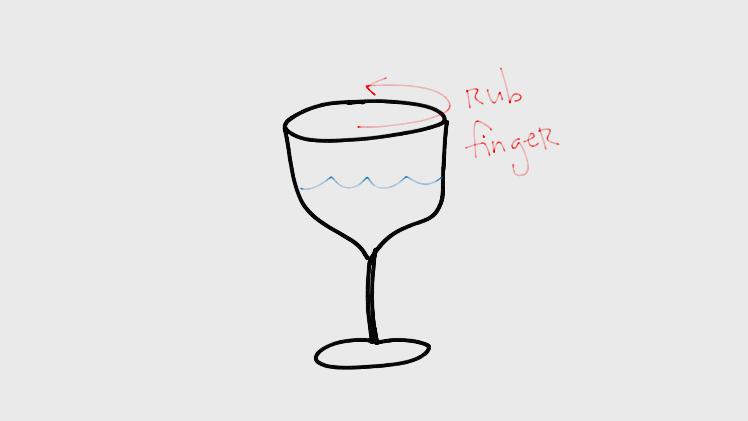
  5. You'll see that the glass begins to "sing!"
  6. Pour out some of the water and repeat the procedure. Think about what you notice.
  7. Add some water so that the glass is more than half full and repeat the procedure. What do you notice when there is more water in the glass?
b1.jpg

Results

What happens when you rub your wet finger around the top of the glass?
 
Which glass produced the highest note? The lowest?
 
Why do you think the glass notes changed when the water level changed? Did we change the ability of the glass to vibrate?
 
What did we cause to produce the sound when we ran our fingers along the top of the glass?
 
Can you think of other situations in which vibration causes noise, now that you have seen this example?

References

Divacratus. "Create some glass music - A fun science experiment for kids!" Retrieved from http://divacratus.hubpages.com/hub/singing-glass

Related videos

These videos explain the science behind this project and demonstrate key concepts used in the experiment.
Share this Science Project:

Related Science Fair Project Ideas

Oobleck and Non-Newtonian Fluids
Squeeze a simple mix of cornstarch and water into a solid ball, then open your hand and watch it flow back into a liquid.
Easy
Cornstarch Oobleck and Shear Thickening
Punch a bowl of cornstarch and water and discover a liquid that turns solid under force, then flows the moment you stop.
Easy
Capillary Action Walking Rainbow
Connect cups of colored water with paper towels and watch capillary action build a complete rainbow overnight.
Easy