

Water Displacement and Rock Density
Medium
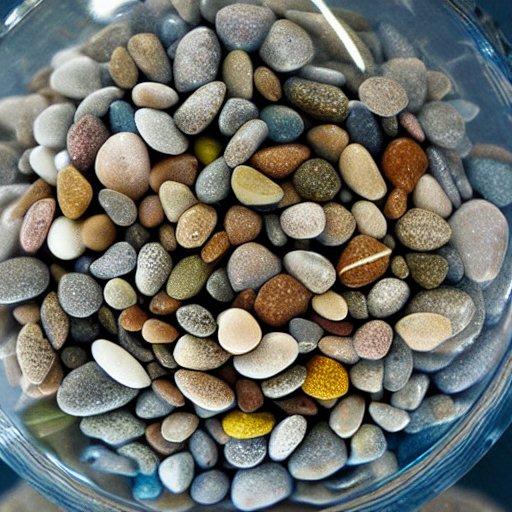
How do you measure the volume of a rock that has no flat sides? You cannot use a ruler on an irregular shape. But you can drop the rock into water and measure how much the water level rises.
You weigh each rock on a balance and record its mass. Then you lower it into a graduated cylinder and note the water level change. Dividing mass by volume gives you the density (how much matter fits in a given space). Comparing different rocks shows which types are denser.
Hypothesis
The hypothesis is that different kinds of rocks will have different densities.
Method & Materials
You will use water displacement to find the volume of each rock. Fill a graduated cylinder half-way with water and place it into an overflow can. Put one rock in and note the volume of the water. The difference of the water volume is the volume of the rock. Measure the rock’s mass with a triple beam balance. With the volume and mass of the rock, you can calculate the density of the rock using the formula density = mass/volume.
You will need rocks of different types (approximately 3 cm in width, height, and length), a triple beam balance, a graduated cylinder, an overflow can, and water.
Tinker Crate — science & engineering build kits for ages 9–12 — real tools, real experiments, delivered monthly. (Affiliate link)
See what’s includedResults
Different kinds of rocks have different densities. Density is determined by the types of material the rocks are made of and how closely they were packed during formation. The volume of irregularly shaped rocks can be accurately measured using water displacement.
Why do this project?
This science project is interesting because it explores the physical properties of rocks and uses water displacement to measure the volume of irregularly shaped objects.
Also Consider
Experiment variations to consider include testing the density of rocks found in different locations or comparing the densities of rocks of different sizes or shapes.
Full project details
Additional information and source material for this project are available below.Related video
These videos explain the science behind this project and demonstrate key concepts used in the experiment.
Ever wondered how to measure the density of a rock, regardless of its shape? Using water displacement with a graduated cylinder is a great way to do that! And if the rock is too large, an Eureka can, also known as a density can, can do the trick!
Share this Science Project:
Browse by Grade
Related Science Fair Project Ideas
Transform crayons into three types of model rocks and see how the real rock cycle works.
Medium
Reshape Starburst candies with heat and pressure to model how the Earth forms three types of rock.
Medium
Use chocolate shavings and heat to build three types of model rock that match real geology.
Medium
Share this Science Project: