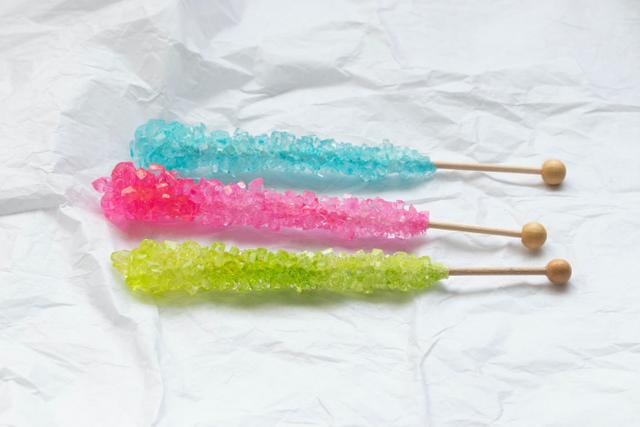
Can you grow a giant crystal from nothing but sugar and water? When you heat water, it can hold more sugar than usual. This is called a supersaturated solution (a liquid holding more dissolved material than normal).
You dissolve sugar in boiling water until no more will mix in. Then you hang a string or stick in the liquid and wait. Over several days, sugar molecules stack onto the string and form large crystals you can eat.
Hypothesis
The hypothesis is that if sugar water is left to evaporate, sugar crystals will form on a string or stick, creating a rock candy treat.
Hot water can hold more dissolved material than cool water — that is what supersaturation means. When you heat water and keep adding sugar until no more will mix in, you have a supersaturated solution. As the liquid cools, the extra sugar can no longer stay dissolved. Those sugar molecules need somewhere to go, so they stack onto the string you have hung in the jar and slowly build into large crystals you can eat.
Crystallization happens when dissolved sugar forms solid shapes as water slowly dries up. In this experiment, you hang a string in sugar water and wait about 7 days. Sugar molecules stack onto the string and form large crystals as the water evaporates.
Method & Materials
You will heat up sugar and water in a saucepan, dissolve the sugar, and let it cool. Then, you will tie a string to a weight, dip it in the sugar water, and let it dry for a few days to form sugar crystal seeds. Once the string is dry, you'll hang it in the sugar water and wait for sugar crystals to form on it, about 7 days.
You will need sugar, water, a saucepan, a wooden spoon, a candy thermometer, a glass jar, cotton string, a weight, waxed paper, and a pencil.
Tinker Crate — science & engineering build kits for ages 9–12 — real tools, real experiments, delivered monthly. (Affiliate link)
In conclusion, making rock candy can teach us about the amazing world of crystallization. To grow crystals on a string, you first need to soak and dry the string to create small seed crystals for larger ones to form around. Two methods contribute to crystal growth: precipitation and evaporation. Precipitation happens when a supersaturated solution becomes unstable and sugar forms a precipitate, while evaporation occurs as water slowly evaporates from the solution and sugar molecules collect on the seed crystals, eventually forming large sugar crystals.
Why do this project?
This science project is interesting because it combines the fun of making candy with the educational experience of learning about crystallization.
Also Consider
Try adding food coloring or flavoring to your sugar water before making the rock candy, or using different types of sugar (such as brown sugar or powdered sugar) to see how they affect the crystal growth.
Full project details
Additional information and source material for this project are available below.
These videos explain the science behind this project and demonstrate key concepts used in the experiment.
Did you know that you can make rock candy by rolling a chopstick in sugar, which is a simpler way to make the seed crystals compared to our experiment? Learn what dissolve, solution and crystallization means!