

Capillary Action Walking Rainbow
Easy
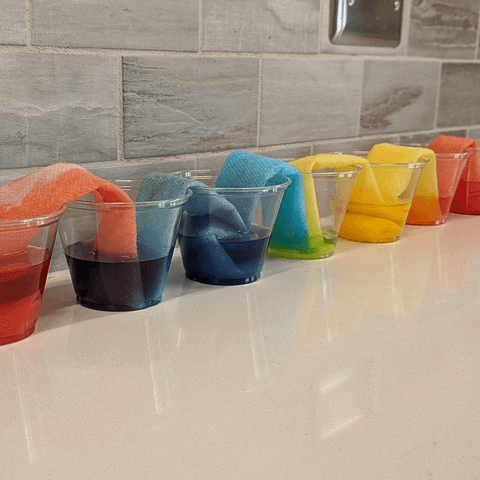
Can water climb upward on its own? It can when paper towels are involved. Water molecules stick to paper fibers and pull more water along behind them. This process is called capillary action.
You line up seven cups in a row. Fill every other cup with water dyed red, yellow, or blue. Then connect all the cups with folded paper towel strips. Over the next few hours, colored water creeps up and over into the empty cups.
When two colors meet in an empty cup, they blend into a new color. By the end you have a full rainbow made entirely by water pulling itself from cup to cup.
Hypothesis
The hypothesis is that the colored water will travel along the paper towels, reaching the empty cups where color mixing occurs, ultimately resulting in a mesmerizing walking rainbow effect.
Science Concepts Learned
Capillary Action
Water sticks to paper fibers and pulls more along. You set up seven cups in a row. Red, yellow, and blue water travels up the paper towels and mixes new colors.
Method & Materials
You will set up seven cups in a row, fill the first with red colored water, the third with yellow colored water, the fifth with blue colored water and the seventh with red colored water. The second, fourth and sixth cups don’t have any water. Place a piece of paper towel between each pair of cups with one end of the paper towel on the bottom of each cup, and watch as a rainbow forms in the cups.
You will need clear cups, paper towels, red, yellow, and blue food coloring, and water.
Kiwi Crate — hands-on STEAM project kits for ages 6–9, delivered monthly. (Affiliate link)
See what’s includedResults
The colored water climbs up the paper towels due to capillary action. When the colored water reaches the empty cups, the two different colors mix, forming a new color! All together, a rainbow is formed from the colored water moving to the empty cups and mixing to form new colors.
Why do this project?
This science project is fascinating because it demonstrates how water can move against gravity through capillary action and also see colors mixing in a visually stunning way.
Also Consider
For variations, you can try using different temperatures of water to see how it affects the speed of absorption, or you can experiment with uneven amounts of water to observe how it impacts the formation of the rainbow.
Full project details
Additional information and source material for this project are available below.Related videos
These videos explain the science behind this project and demonstrate key concepts used in the experiment.
In this demonstration from the Aberdeen Science Centre, glass jars are used in the rainbow walking water experiment, and at the end, all the jars are filled with the colors of the rainbow! The capillary action you see in this rainbow water experiment is also what draws water up through plant roots into the leaves and flowers!
Follow along with these step-by-step instructions for the Rainbow Walking Water science experiment, brought to you by the Miami Children's Museum!
This is a sped up video of the rainbow walking water science experiment from the Science Museum Oklahoma. Notice what happens to the empty glass!
Share this Science Project:
Browse by Grade
Featured In
Related Science Fair Project Ideas
Squeeze a simple mix of cornstarch and water into a solid ball, then open your hand and watch it flow back into a liquid.
Easy
Punch a bowl of cornstarch and water and discover a liquid that turns solid under force, then flows the moment you stop.
Easy
Rub a wet finger along the rim of a stemware glass and discover how the water level changes the pitch.
Easy
Share this Science Project: