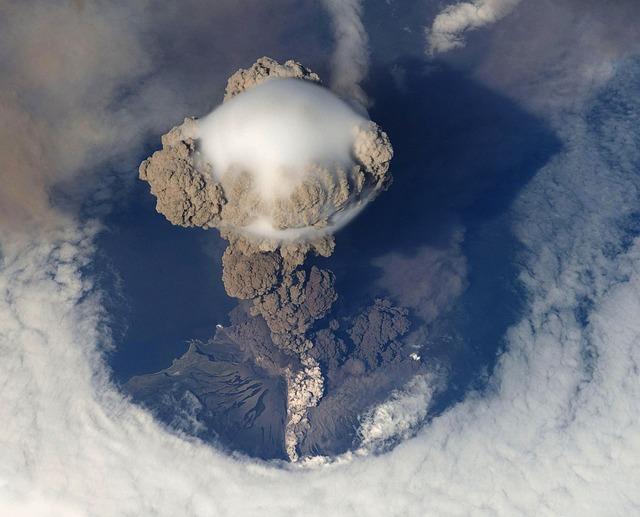
How does a volcano scatter rock and ash across the landscape? Real eruptions launch fragments called tephra (broken rock and ash) high into the air. Wind carries lighter pieces farther from the vent.
You build a model using a plastic funnel and tubing connected to pressurized air. Sand pours into the tube through the funnel. Air pressure shoots the sand upward like a lava fountain. A fan blows the airborne sand sideways.
After several bursts, the sand forms a cone with a crater in the center. Coarse grains land close to the vent. Fine grains travel farther downwind, just like real tephra deposits.
Hypothesis
The hypothesis is that air pressure can be used to simulate a volcanic eruption.
Air pressure is the push of air on everything around it. In this experiment, pressurized air shoots sand upward like a lava fountain. The moving air pushes sand grains into the sky, and a fan blows them sideways. Coarse grains land near the vent while fine grains travel farther downwind.
When a volcanic eruption occurs, hot melted rock, gases, and ash burst out from inside Earth — and real eruptions launch fragments called tephra high into the air. Wind carries lighter pieces farther from the vent, spreading them across the landscape. You can model this same process by connecting pressurized air to a plastic funnel and tubing, so air pressure shoots sand upward like a lava fountain. As a fan blows the airborne sand sideways, coarse grains land close to the vent while fine grains travel farther downwind, just like real tephra deposits.
When a volcano erupts, it launches broken rock, ash, and debris high into the sky — fragments collectively called tephra. Wind carries lighter pieces farther from the vent, while heavier chunks land close by, forming a recognizable pattern across the landscape.
Method & Materials
You will assemble the apparatus as shown in the diagram, feed sand down to the "eruption" using the funnel, and use a fan to blow air across the sand as it leaves the "vent."
You will need sand or cinder, pressurized air, a plastic funnel, plastic tubing, a plastic T-joint, and a white sheet or white cardboard.
Eureka Crate — engineering & invention kits for ages 12+ — monthly projects that build real-world skills. (Affiliate link)
We were surprised by the results! After the sand was ejected it made beautiful cones, much like cinder cones or tuff rings. The cone even had a central crater.
Why do this project?
This science project is interesting and unique because it uses air pressure to simulate a volcanic eruption and demonstrates how tephra is dispersed downwind to form a cinder cone.
Also Consider
Experiment variations to consider include using a can of compressed air instead of an air jet, and using a fan to blow air across the sand as it leaves the "vent."
Full project details
Additional information and source material for this project are available below.