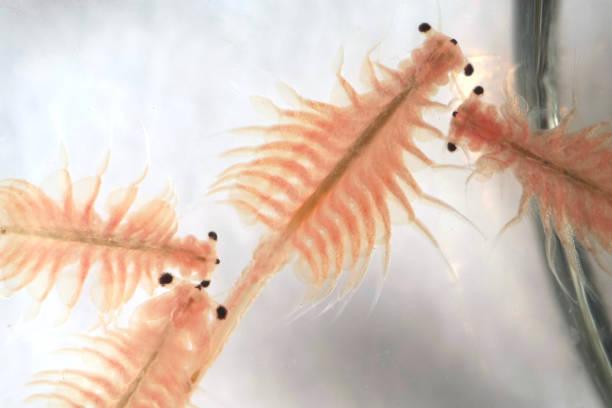
Do brine shrimp prefer warm water or cold water? These tiny creatures (Artemia) survive in many salty environments. This project tests which conditions they choose.
You fill clear plastic tubes with water and brine shrimp. Each tube gets a gradient (a smooth range from weak to strong) of one variable. One tube varies in temperature. Another varies in pH (how acidic the water is). A third varies in light level. A control tube stays at room conditions.
After the shrimp settle you clamp each tube into four equal sections. You count the shrimp in each section and graph where they gather.
Hypothesis
The hypothesis is that changes in the environment such as temperature and light will affect shrimp in their choice of habitats.
These tiny creatures (Artemia) survive in many salty environments, but they do not treat all conditions equally. To find out which ones they prefer, you fill clear plastic tubes with water and brine shrimp. Each tube gets a gradient — a smooth range from weak to strong — of one variable: temperature, pH, or light level. A control tube stays at room conditions. After the shrimp settle, you clamp each tube into four equal sections and count the shrimp in each, graphing where they gather.
When given a choice, animals move toward the conditions they prefer. Brine shrimp (Artemia) placed in clear plastic tubes show this clearly. Each tube holds a gradient — a smooth range from weak to strong — of one variable: temperature, pH, or light level. A control tube stays at room conditions. After the shrimp settle, clamping each tube into four equal sections and counting where they gather reveals which environment they choose over the others.
Method & Materials
You will use controlled experimentation to determine the thermal, pH, and light environments selected by Artemia.
You will need a 100 cm clear plastic tube filled with water and brine shrimp, clamps, and a metric scale to measure the volumes, distances, and temperature.
Tinker Crate — science & engineering build kits for ages 9–12 — real tools, real experiments, delivered monthly. (Affiliate link)
The results of the experiment showed that brine shrimp prefer salty environments and that they are able to survive in a wide range of temperatures, pH levels, and light intensities. The most interesting observation was that the shrimp were divided into four groups based on the intensity of the habitat variables.
Why do this project?
This science project is interesting and unique because it allows students to explore the habitat preferences of brine shrimp and to gain a better understanding of how environmental variables can affect an organism's choice of habitat.
Also Consider
Experiment variations to consider include testing different organisms and different environmental variables.
Full project details
Additional information and source material for this project are available below.