
Voltage and Electric Current
Voltage and electric current is the push and flow of tiny charges through a wire.
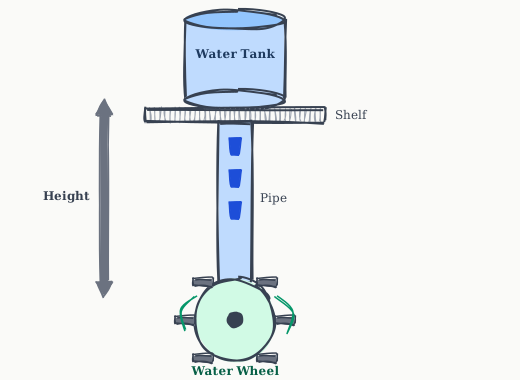
A water tank sits high on a shelf, with a pipe running down to a wheel below. The height of the tank is the voltage — it gives water the push to flow downward. The water moving through the pipe is the electric current. A taller tank means more push and faster flow, just like higher voltage drives more current through a wire.
Explaining voltage and electric current by grade level
A battery gives a push. That push moves tiny bits through a wire. More push means more bits flow. You can see this work when a bulb lights up.
Projects that explore voltage and electric current
Your body can serve as a path for the flow of tiny charges. You mount a copper plate and an aluminum plate on separate pieces of wood, then connect them to a DC microammeter with alligator clips and lead wire. Place one hand on each plate, and the microammeter registers a flow of charges, showing that your body creates an electric current.
Tiny charges need a push and a complete path to flow through a wire. You wrap a nail with wire and attach a reed switch to a matchbox to build a circuit with a battery. The battery supplies the push, and charges flow through the wire whenever the reed switch completes the path.
A telegraph turns the push and flow of tiny charges into a signal you can read. You build two stations from cardboard and wire, each with a thumbtack switch and a light. Press the switch on one station and charges flow through the wire — the light on the other station turns on. Release it and the flow stops. Short presses make dots and long presses make dashes, which you string together to spell out words one letter at a time.
Different metal pairings produce different amounts of push when you build an electrochemical cell. You place zinc, copper, and lead sheets in their own nitrate solutions, separated by a porous cup, then connect wires to a voltmeter and record the reading for each combination. The metal pairing controls how much voltage the cell produces, so each reading differs. By testing all three pairings, you discover which metals generate the highest voltage output.
The push that moves tiny charges through a wire comes in measurable amounts called volts, and the metal combination controls how much push a galvanic cell produces. You test three pairs — lead-copper, copper-zinc, and zinc-lead — each sitting in matching sulfide solutions connected by a salt bridge. A digital voltmeter reads the exact voltage each pair produces. The lead-copper pair generates the highest at 0.473 V, while the zinc-lead pair produces only 0.049 V — nearly ten times less push.