Search for Science Fair Projects

1000 Science Fair Projects with Complete Instructions

Rear Fog Lights and Distance Estimation

Rear Fog Lights and Distance Estimation

Hard
Share this Science Project:
This page contains full project details. For the summary, please see the Project Summary.

Science Fair Project Description

This experiment was done to investigate the effectiveness of using 1 rear fog light on the rear of a vehicle to assist in the estimation of distance, compared with 2 rear fog lights and and no fog lights at all.
Complexity level:8
Project cost ($):200
Time required:1 hour to prepare, 1 day for experiment
Material availability:4 cars, 3 of which are of a similar make and model are required. Fog machines will need to be leased for the purposes of this experiment
Safety concerns:

Hypothesis

The use of 2 rear fog lights will improve the driver's ability to estimate distance.
 

Overview

http://hfs.sagepub.com/cgi/content/abstract/43/3/442

http://www.wisegeek.com/what-are-fog-lights.htm

Scientific Terms

Fog, visibility

Materials

The materials required for the experiment:

-    A back lane or narrow corridor measuring 40 meters long
-    10 licensed drivers with at least 3 years driving experience
-    1 car fitted with 1 rear fog light
-    1 car fitted with 2 rear fog lights
-    1 car without any rear fog lights
-    1 car to be driven by the participants
-    2 fog machines
-    A long measuring tape (at least 15 meters in length)
-    An assistant

Eureka Crateengineering & invention kits for ages 12+ — monthly projects that build real-world skills. (Affiliate link)

See whats included

Procedure

1.    For this experiment, the independent variable is the number of fog lights on the car. The dependent variable is the distance between the cars. The distance is measured using a measuring tape. The constants (control variables) are the amount of fog created by the 2 fog machines, the make and model of the cars used for the experiment and the driving experience of the participants.

2.    Ten drivers with 3 years minimum driving experience are selected. Very that they have good eyesight for the purposes of the experiment.

3.    On the day of the experiment, the 10 participants are brought to the testing area (a 40 meter long and straight back lane).

4.     The car without the fog light is parked at one end of the back lane so that the rear lights of the car are visible from the other end of the same lane. The car lights are turned on so that the drivers can see the red rear lights.

5.    The fog machines are switched until the entire 40 meter length of the back lane is covered with fog.

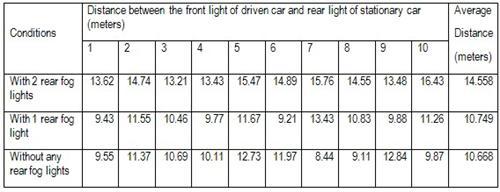
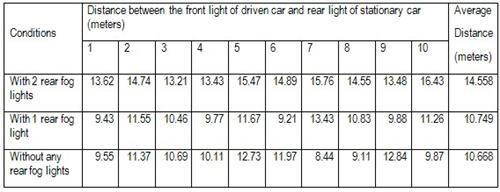
6.    The 10 drivers are asked, one at a time, to drive the second car . They are asked to stop approximately 10 meters away from the car parked in front. The distance from the front of the driven car to the rear of the stationary car is recorded in the table given below.

7.    Procedure 6 is repeated with the car that has 1 rear fog light and the car with 2 rear fog lights and all the data is recorded in the table below.
 

b1.jpgb2.jpg

Results

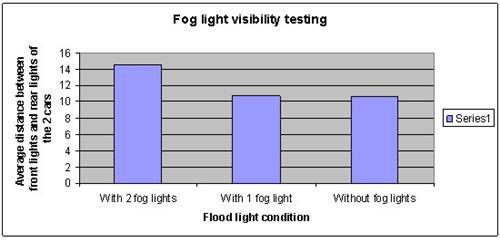
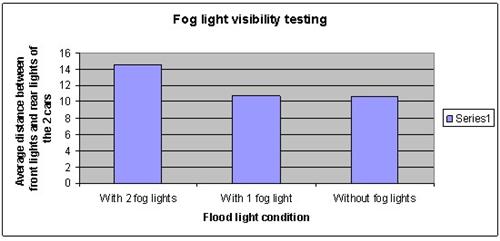
The results show that using 1 rear fog light and no rear fog lights causes the stationary vehicle to appear further away than it actually is.
fog lights science project automobile fog light science fair project

Conclusion

The hypothesis that the use of 2 fog lights will improve the estimation of distance by drivers is proven to be true.

Fog lights help to improve visibility . It enables the drivers of the cars behind yours  better estimate the distance to your car in front. 


Also consider

The experiment can also be done by adjusting the height of the fog lights.

This experiment can also be repeated by using red or yellow fog lights.

The experiment can be attempted at night to see if a difference in results will occur.
 

References

Distance perception of vehicle real life in fogs - http://hfs.sagepub.com/cgi/content/abstract/43/3/442

What are fog lights? - http://www.wisegeek.com/what-are-fog-lights.htm
 

Related videos

These videos explain the science behind this project and demonstrate key concepts used in the experiment.
Share this Science Project:

Related Science Fair Project Ideas

Rush Hour Traffic and Vehicle Emissions
Record 18 hours of highway traffic on video and score each time window for speed, volume, and pollution potential.
Hard
Tire Pressure and Fuel Mileage
Drive five cars on the same fuel supply at full and reduced tire pressure to measure how much mileage changes.
Hard
Driving Speed and Fuel Economy
Give five cars the same fuel at 90 and 110 km/h to measure how much farther the slower speed goes.
Hard