Search for Science Fair Projects

1000 Science Fair Projects with Complete Instructions

Goldfish and Elodea Plant Growth

Goldfish and Elodea Plant Growth

Medium
Share this Science Project:
This page contains full project details. For the summary, please see the Project Summary.

Science Fair Project Description

This science fair project was performed to determine if an Elodea plant can grow faster when planted in aquariums occupied by goldfish. The experiment was done by growing Elodea in an aquarium with one, five and ten goldfish and also in a tank without any goldfish.
Complexity level:6
Project cost ($):80
Time required:1 hour to prepare, 7 days for observation
Material availability:May be acquired from a pet store
Safety concerns:

Hypothesis

The Elodea plant will grow faster in the aquarium with goldfish. The greater the number of goldfish, the better the rate of growth.

Overview

Plants in an aquarium

Aquatic plants add more natural beauty to a fish tank. They also help clean the water and reduce the growth of algae. However, conditions in the aquarium must be suitable for both fish and plant. The types of plants that can be introduced into an aquarium include rooted plants and floating plants.

Fish feed and produce waste daily. Aquariums normally have filters which help to clean and remove some of this waste from the water. Most of this waste is in the form of nitrates and nitrites. They are the same nutrients required by aquatic plants to grow. Therefore, having more plants in an aquarium can help to lower nitrate levels in the water. This also means less algae growth and less frequent cleaning of the tank.

The gills of fishes absorb oxygen from the water and produce carbon dioxide. Plants living in the water need the carbon dioxide for photosynthesis and growth. Aquatic plants produce oxygen which is needed for the fish’s respiratory function. Plants in the aquarium are also used as food and as places for fish to hide. This symbiotic relationship is beneficial to both fish and plants.
 

Scientific Terms

Nitrate, nitrite, algae, photosynthesis

Materials

The materials required for this science fair project:

-    12 Elodea plants
-    4 fish tanks of the same size
-    16 goldfish
-    Enough water to fill 4 fish tanks
-    A pack of fish food
-    4 aquarium filters
-    4 aquarium lights
-    1 meter-long ruler

Tinker Cratescience & engineering build kits for ages 9–12 — real tools, real experiments, delivered monthly. (Affiliate link)

See whats included

Procedure

1.    For this science fair project, the independent variable is the number of goldfish in the tank i.e. none, one, two and three goldfish. The dependent variable is the average growth of the Elodea plants. This is determined by measuring and calculating the average height of the plants after 7 days. The constants (control variables) are the size of the aquarium, the amount of water in the aquarium and the amount of light received by the plants.

2.    4 fish tanks are filled with the same amount of water. The aquarium lights and filters are installed into the 4 fish tanks.

3.    The height of the 12 elodea plants are measured using a ruler. The plants are separated into 4 bunches of 3 plants each. The average height of the plants in each group are calculated and the results recorded in the table below.

4.    One bunch of Elodea plants are placed in each of the 4 aquariums. The 1st aquarium will not have any gold fish. The 2nd, 3rd and 4th aquarium will each have one, two and three goldfishes. The aquarium filter is switched on. The aquarium light is left on for 10 hours a day.

5.    After 7 days, the Elodea plants are removed from the aquarium and their average heights calculated again. The results are recorded in the table below.
 

b1.jpg

Results

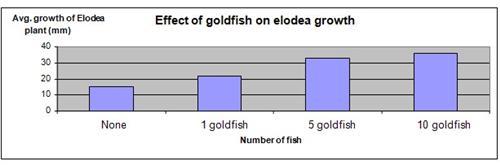
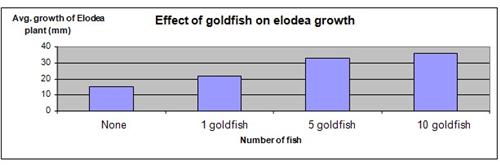
It is observed that the Elodea plants grew faster in the fish tanks that contained goldfish.
 

Number of goldfish None 1 goldfish 5 goldfish 10 goldfish
Initial elodea length (mm) 97 99 96 96
Final elodea length (mm) 112 121 129 132
Average growth (mm) 15 22 33 36

The graph below represents the results of our science project.
 

Elodea and Goldfish Science Fair Project

Conclusion

The hypothesis that the Elodea plant will grow faster in an aquarium containing goldfish, is correct.

Growing aquatic plants in a goldfish tank adds beauty to the aquarium. They also help to remove ammonia and nitrate waste produced by the goldfish. However, it is important to choose the right type of aquatic plants for the goldfish. The best aquatic plants for goldfish are ones that can withstand nudges from goldfish and those with strong roots. Otherwise, aquatic plants that do no thrive will decay and rot and will adversely affect the quality of the water in the aquarium.
 

Also consider

The science fair project can also be repeated by using other types of aquatic plants like the Anubias or Sword plant.

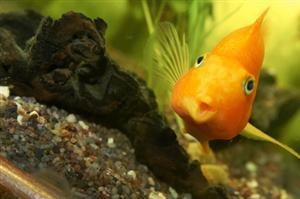
Try and repeat the experiment by using different  types of fish (eg. Parrot fish).
 

References

Plants in a goldfish aquarium - http://www.desktopgoldfish.com/goldfish-aquarium-plants.php

Why keep life aquatic plants? - http://www.aquariumfish.net/catalog_pages/plants/plant_advice.htm
 

Related videos

These videos explain the science behind this project and demonstrate key concepts used in the experiment.
Share this Science Project:

Related Science Fair Project Ideas

Soybean Seed Mass and Emergence Speed
Sort soybean seeds by weight and test whether heavier or lighter seeds push through 10 centimeters of soil faster.
Medium
Soil-Borne Disease in Pea Plants
Plant pea seeds in 14 different soil samples and track which root diseases appear most often as the plants grow.
Medium
Vegetative Propagation Methods Compared
Clone a plant using leaf cuttings, stem cuttings, or layering and compare which method grows new roots first.
Medium