| Complexity level: | 6 |
| Project cost ($): | 20 |
| Time required: | Preparation will require one day, while observation and recording of data will be carried out over a period of three days |
| Material availability: | Access to laboratory equipment (eg. petri dishes) |
| Safety concerns: |
Hypothesis
The slice of cucumber will be most prone to germ contamination.
Overview
Germs
Germs consist of various types of microscopic organisms such as bacteria, virus, protozoa and fungi. Although germs exist everywhere around us, they can only survive for a few hours or days on a surface. These germs will be transferred to our hands and bodies when we touch or come in contact with these surfaces.
Bacteria survive by obtaining nutrients that they need from their surrounding environment. Some bacteria are beneficial to humans, as they help us digest our food and protect us from other harmful germs. However, bacteria such as pathogens are harmful to us and will cause diseases. Vaccines are medicines that act against bacteria and enhance our immune system.
Viruses are another component of germs, and are dependent on a host to survive. In the absence of a host, viruses can only live for a short period of time. However, once they encounter a suitable host, they will enter the cells of the host and replicate inside the host cells. This process leads to illnesses, such as the common cold and aids, in their host.
Two other types of germs are protozoa and fungi. The former is a single-celled microorganism that exists in humid conditions and infects others through contaminated water, whereas the latter is a multi-celled organism and is quite harmless, unless the person in contact with it has a weak immune system.
Scientific Terms
Materials
Materials required for this science fair project:
- 8 agar Petri dishes
- 80 disinfected swabs
- 1 bottle of disinfected water
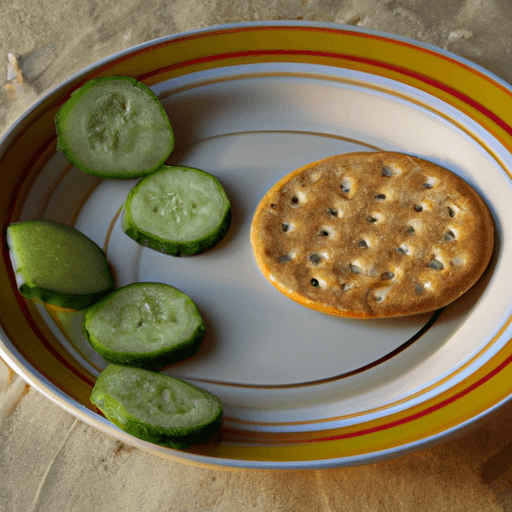
- 1 box of cheese crackers
- 1 cucumber
- 1 knife
- 1 chopping board
- 1 box of sterilized rubber gloves
- 1 stopwatch
- 2 sterilized plastic bags
Procedure
1. The independent variable in this science fair project are the locations where the cheese cracker and cucumber slice were placed – kitchen sink, toilet floor, car porch or garden grass. The dependent variable is the amount of bacterial growth in the Petri dishes, which is determined by counting the number of bacteria colonies. The constants (control variables) are the temperature of the room, the amount of sunlight, and the ingredients used to make the agar in the Petri.
2. Store the eight Petri dishes in a refrigerator. Before the start of the experiment, take the Petri dishes out of the refrigerator and allow them to warm to room temperature. Label the Petri dishes as wet sink, wet floor, wet porch, wet grass, dry sink, dry floor, dry porch and dry grass.
3. Wear the sterilized rubber glove and wash the chopping board and knife using the sterilized water. Wash the cucumber and cut it into slices before keeping it in the sterilized plastic bag. Next, open the box of cheese crackers and transfer the crackers into another sterilized plastic bag.
4. Using a new sterilized rubber glove, drop a slice of cucumber into the kitchen sink. Start the stopwatch and pick up the slice of cucumber after 20 seconds. Rinse a swab with disinfected water before rubbing it over the surface of the cucumber slice. Swab over the surface of the Petri dish labeled as wet sink. Repeat the procedure for ten times, each time using a new slice of cucumber and a new swab.
5. Repeat procedure 4 using a piece of cheese cracker biscuit. Make ten dots using disinfected swabs in the Petri dish labeled as dry sink.
6. Repeat procedures 4 and 5 by placing sliced cucumbers and cheese crackers on the toilet floor, car porch and garden grass.
7. Keep the eight Petri dishes in a cool and dry place for the next three days. This is to allow the bacteria to grow. Count the number of bacteria colonies after three days and record in the table given below.

Results
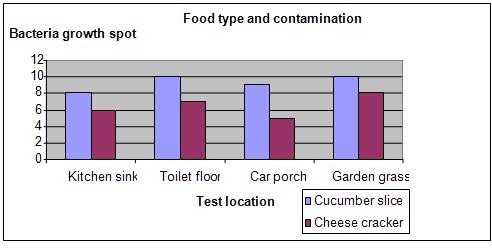
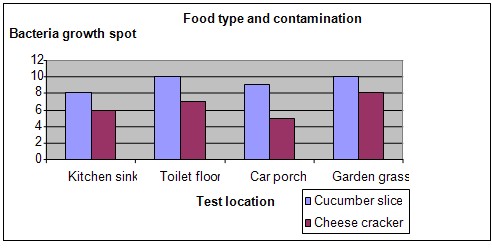
Petri dishes swabbed with samples from the cucumber slices (wet food) were observed to have more bacterial growth spots than the Petri dishes swabbed with samples from the cheese crackers (dry food).
| Food type | Number of bacterial coloniesfrom samples of wet and dry food | |||
| Kitchen sink | Toilet floor | Car porch | Garden grass | |
| Cucumber slice | 8 | 10 | 9 | 10 |
| Cheese cracker | 6 | 7 | 5 | 8 |
Use the graph below to plot the experimental data recorded in the table above.

Conclusion
The experimental data and analyzed results support the hypothesis that cucumbers (wet food) are more prone to contamination by germs.
It is important to maintain our personal hygiene and the cleanliness of our environment at all times in order to protect ourselves from harmful germs. We must always practice good habits such as washing our hands before touching food, and bathing everyday to minimize contact with germs and to lead a healthy life.
Also consider
This science fair project can be repeated in other locations such as the school, parks etc.
Try to repeat the experiment using other types of food such as jelly, apples and candies.
References
What are germs? - http://kidshealth.org/parent/general/sick/germs.html#
Germs, they are everywhere - http://www.webmd.com/parenting/news/20040623/germs-theyre-everywhere