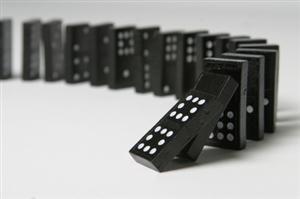
How does the gap between dominoes change the speed of the chain reaction? The answer is not as simple as "closer is faster."
You line up 100 dominoes at seven different spacings. The gaps range from 10 mm to 40 mm. You knock over the first tile and time how long the full chain takes to fall.
The speed peaks at a 30 mm gap and drops on both sides. Too close or too far apart both slow the chain down.
Hypothesis
The hypothesis is that as the distance between the dominoes is increased, the speed of their toppling decreases.
The spacing between dominoes controls how fast a topple travels — and closer is not always faster. Line up 100 dominoes at seven different gaps ranging from 10 mm to 40 mm, knock over the first tile, and time the full chain. Speed peaks at a 30 mm gap and drops on both sides. Too close, and each falling tile barely reaches the next. Too far apart, and each tile loses too much energy before triggering the one ahead. When each step needs just the right distance to trigger the next one, the chain runs fastest.
Wave propagation moves energy from one place to another without carrying matter along. You arrange 100 domino tiles in a row and time how long they take to topple over. Each tile stays in place, but the energy moves down the line from the first tile to the last.
Method & Materials
You will arrange 100 domino tiles in a row, measure the distance between them, and time how long it takes for them to topple over.
You will need 100 domino tiles, a measuring tape, a ruler, a stopwatch, and a flat floor.
MEL Physics — hands-on physics experiment kits delivered monthly — real experiments, not just reading. (Affiliate link)
The results showed that the speed of the tiles declined when the gap was increased from 10mm to 15mm. As the distance of the gap increased from 15mm to 30mm, the speed of the tiles increased. Beyond a gap distance of 30mm, the speed of the tiles continued to decline.
Why do this project?
This science project is interesting because it demonstrates the domino effect, which is a chain reaction of events that can be triggered by a single action.
Also Consider
Variations: What would happen if the science fair project was repeated by using different sizes of domino blocks or Lego blocks? Try to repeat the science fair project by arranging 200 tiles or 300 tiles and measuring the speeds again.
Full project details
Additional information and source material for this project are available below.