Search for Science Fair Projects

1000 Science Fair Projects with Complete Instructions

Athlete Heart Syndrome, Age, and Pulse Pressure

Athlete Heart Syndrome, Age, and Pulse Pressure

Hard
Share this Science Project:
This page contains full project details. For the summary, please see the Project Summary.

Science Fair Project Description

This science fair project was conducted to find out the effects of age on the pulse pressure of a person having Athletic heart syndrome (AHS). The science fair project involved participants from 3 age groups - young participants (15-30 years old), middle aged (31 to 45 years old), senior participants (45 to 60 years old).
Complexity level:7
Project cost ($):50
Time required:1 day to prepare, 1 day for the science project experiment
Material availability:You will need a portable blood pressure monitor. These are fairly inexpensive and easily available.
Safety concerns:

Hypothesis

Athletes with AHS have a higher pulse pressure compared to normal persons, and the pulse pressure increases as they age.

Overview

Athlete Heart Syndrome (AHS)

AHS is a medical condition where the heart of a person becomes enlarged due to prolonged exercise. This condition is common in athletes who train for many hours everyday. Although the condition is harmless, it is difficult to distinguish AHS from other more serious medical conditions.

When an athlete performs prolonged and intensive exercises, the heart will need to pump more blood and oxygen to his muscles. If the exercise is a daily routine, the heart will expand in order to adapt to the requirement for additional oxygen, by becoming enlarged. This will enable the heart to supply more blood and oxygen to the muscles during these periods of high demand. As a result, athletes tend to have lower heart rates during periods of rest.

Another significant reading is pulse pressure. This reading is the difference in blood pressure between systolic and diastolic readings. Normally during exercise, the systolic pressure will increase while the diastolic pressure will remain about the same. This will cause pulse pressure to increase during exercise.

Scientific Terms

Athlete heart syndrome, heart, heartbeat, pulse pressure, systolic, diastolic

Materials

The materials required for this science fair project:
- 10 athletes aged between 15 and  30 years, diagnosed with AHS
- 10 athletes aged between 31  and 45 years, diagnosed with AHS
- 10 athletes aged between 46  and 60 years, diagnosed with AHS
- 10 non-athletes aged between 15  and 30 years
- 10 non-athletes aged between 31  and 45 years
- 10 non-athletes aged between 46  and 60 years
- A blood pressure checking device

Procedure

1. For this science fair project, the independent variable is whether or not the participants have AHS, and the age of the participants. The dependent variable is the pulse pressure of the participants. This is determined by using the blood pressure monitor, to  take measurements. The constants (control variables) are the health of the participants and the accuracy of the blood pressure checking device.

2. 60 participants are required for this science project. They are divided into 3 age groups of 15 to 30 years, 31 to 45 years and 46 to 60 years. Each group will have 10 participants who are, or were, athletes and another 10 non-athletes. Other than AHS, all participants must not be having any medical condition like hypertension, heart disease or be on any medications.

3. The participants are brought into the room and made to sit and relax. The participant’s heartbeat rate, systolic blood pressure readings and diastolic blood pressure readings are measured using the blood pressure monitor. The pulse pressure of the participants is obtained by deducting the diastolic pressure from the systolic pressures.

4. The average heartbeat rate and pulse pressure for each group of participants is calculated by totaling the 10  readings and dividing  by 10. The calculated values are recorded in the table given below.

b1.gif

Results

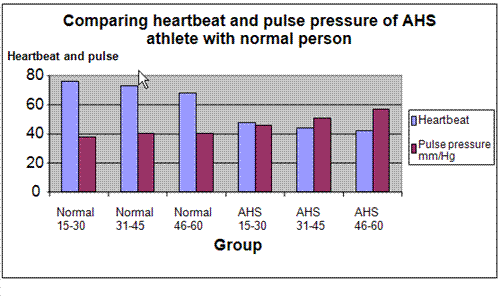
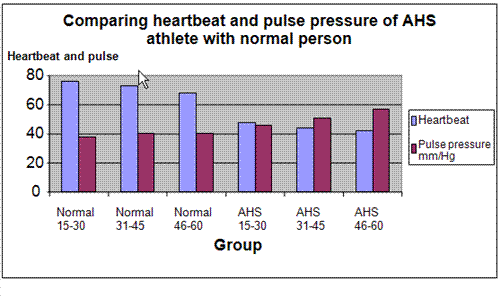
It  was observed that the participants with AHS (athletes and former athletes) had a lower heart rate but their pulse pressure  was higher than the normal (non-athlete) persons. The pulse pressure of the participants also increased with age.

Measurement

Comparing heart rates and pulse pressure of non-athletes and athletes with AHS

Non-athlete 15-30

Non-athlete 31-45

Non-athlete 46-60

AHS 15-30

AHS 31-45

AHS 46-60

Heart rate

76

73

68

48

44

42

Pulse pressure mm/Hg

38.3

39.8

40.5

46.1

51.3

56.9

The chart below represents the results of our science project experiment:
athlete heart syndrome science project

Conclusion

The hypothesis that  athletes with AHS  have higher pulse pressure compared with normal persons and that their pulse pressure also increases as they grow older is proven to be true.

Recent studies have shown that a high pulse pressure reading increases the risk of heart disease. An increase in pulse pressure of 10mm/Hg can cause the risk of cardiovascular complications to rise by 20%. Pulse pressure can be easily monitored at home using portable blood pressure monitors.

Also consider

What would happen if the science project was repeated comparing the physiological differences between male athletes and female athletes?

The science project experiment can be further enhanced by conducting a survey to compare the occurrence of heart disease among athletes and non-athletes.

References

Athlete heart syndrome - http://en.wikipedia.org/wiki/Athletic_heart_syndrome

Pulse pressure - http://en.wikipedia.org/wiki/Pulse_pressure

Related videos

These videos explain the science behind this project and demonstrate key concepts used in the experiment.

Share this Science Project:

Related Science Fair Project Ideas

Nasal Dilators and Snoring Reduction
Record ten snorers sleeping with and without a nasal strip, then compare how many minutes of snoring each night produces.
Hard
Yoga and Blood Pressure
Compare blood pressure readings over seven days between a group practicing yoga and a group watching television to see which routine brings numbers down.
Hard
Turmeric as an Antioxidant in Daphnia
Watch daphnia heart rates spike from an oxidant, then add turmeric juice and see if the rate drops.
Hard