Search for Science Fair Projects

1000 Science Fair Projects with Complete Instructions

Bacteria on Everyday Surfaces

Bacteria on Everyday Surfaces

Medium
Share this Science Project:
This page contains full project details. For the summary, please see the Project Summary.

Science Fair Project Description

This science fair project was done to compare the amount of germs found in the places that we touch. The testing was done by obtaining samples from the handle of a shopping trolley, computer keyboard, the button/handle of a water cooler, buttons on a lift, and a door knob.
Complexity level:7
Project cost ($):20
Time required:1 day to prepare, 5 days for the science project experiment
Material availability:Easily found
Safety concerns:

Hypothesis

Continuously damp places such as the button/handle of a water cooler will have the highest amount of germs.

Overview

Germs

Germs are microscopic organisms that are found everywhere around us. They consist of bacteria, viruses, fungi and protozoa. Most germs are able to survive on surfaces for as long as a few hours to a few days, before they are transferred to our hands and body when we touch .

Germs like bacteria are able to obtain nutrients that are needed for their survival, directly from their environment. Most of these bacteria are harmless to us. They help us digest our food and also protect us from other harmful germs. Bacteria are also used to produce vaccines and medications. Some bacteria called pathogens are harmful and can make us ill.

Another type of germ, the virus, is dependent upon a host in order to survive. Outside of the host, they are able to survive for only a short period of time. However, once they inhabit a host, viruses will multiply and cause damage to the host’s body cells and make the host sick. Viruses are responsible for diseases like the common cold and AIDS.

Yet another type of germ is the multi-celled fungi. Unless a person has a very weak immune system, fungi are quite harmless to humans. Protozoa are single celled organisms that live in humid conditions and cause infection by contaminating water.

Scientific Terms

Germs, microscopic organisms, bacteria, fungi, virus, protozoa, vaccines

Materials

The materials required for this science fair project:
- 5 agar petri dishes
- 5 disinfected swabs
- 1 bottle of disinfected water
- 1 marker pen

Procedure

1. For this science fair project, the independent variable is the locations the swabs are wiped to sample for germs. The dependent variable is the number of bacteria colonies that grown in each petri dish. This is determined by observing and counting the bacteria colony spots. The constants (control variables) are the room temperature, the amount of sunlight and the ingredients in the petri dishes.

2. The four petri dishes are stored in a refrigerator. The petri dishes are brought to room temperature before the start of the science experiment, by taking them out of the refrigerator and allowing them to attain room temperature. The petri dishes are labeled A, B, C, D and E.

3. The sterilized swab is first made damp using  sterilized water.  The swabs are rubbed in the  following  places and then rolled and rubbed in the petri dishes.

a. Rub the swab on  the handle of the shopping trolley and then roll it over the agar in petri dish A.

b. Rub the swab on  a computer keyboard and then roll it over the agar in petri dish B.

c. Rub the swab on the water cooler handle and then roll it over the agar in petri dish C.

d. Rub the swab on a lift button and then roll it over the agar in petri dish D.

e. Rub the swab on a door knob and then roll it over the agar in petri dish E.

4. The cover is closed and the 5 petri dishes are kept in a cool place for the bacteria to cultivate.

5. The number of  bacteria colonies  is counted after 5 days and recorded in the below table.

b1.gif

Results

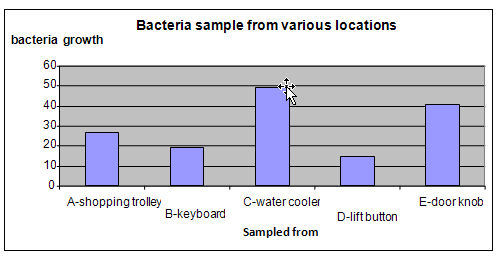
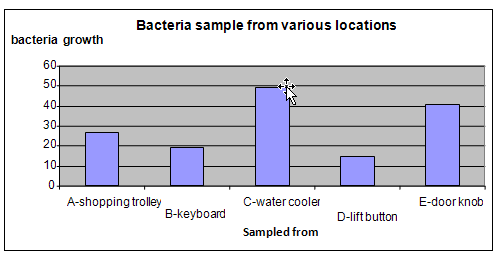
The results showed that petri dish C (water cooler) and E (door knob) had the largest bacterial growth.

Bacteria growth

Number of bacteria colonies after 5 days

A-shopping trolley

B-keyboard

C-water cooler

D-lift button

E-door knob

Number of spots

27

19

49

15

41

The graph below represents the results of our science fair project:
germs science fair project

Conclusion

The hypothesis that  constantly damp places  have the highest amount of germs is proven to be true.

Maintaining proper personal hygiene is important in protecting ourselves from harmful germs that can make us sick. Habits like washing  our hands with soap before touching or handling food and maintaining the cleanliness of our living environment by regular wiping and cleaning can help us to lead a healthy and quality life.

Also consider

The science project experiment can be repeated to test for bacteria at locations like restaurants, schools and other public areas to compare the results.

Try to repeat the science project experiment using personal items like mobile phones, wallets, watches, etc.

References

What are germs? - http://kidshealth.org/parent/general/sick/germs.html#

Germs, they are everywhere - http://www.webmd.com/parenting/news/20040623/germs-theyre-everywhere

Related videos

These videos explain the science behind this project and demonstrate key concepts used in the experiment.
Share this Science Project:

Related Science Fair Project Ideas

Bacteria Levels in Fresh, Frozen, and Irradiated Chicken
Swab fresh, frozen, and irradiated chicken onto agar plates and measure which processing method leaves the fewest bacteria behind.
Medium
Bacteria Carried by Common Insects
Let four insects walk across agar dishes and measure which one leaves behind the largest colony of bacteria after five days.
Medium
Bacteria Levels in Waterless vs. Water-Based Urinals
Swab five waterless and five water-based urinals, grow the bacteria in petri dishes, and measure which type produces larger colonies.
Medium