Search for Science Fair Projects

1000 Science Fair Projects with Complete Instructions

DC Electricity and Radish Growth

DC Electricity and Radish Growth

Medium
Share this Science Project:
This page contains full project details. For the summary, please see the Project Summary.

Science Fair Project Description

This science fair project was conducted to find out how electricity affects the growth of plants. The experiment was done by supplying DC 9V to the soil containing radish seeds and observing the rate of plant growth.
Complexity level:8
Project cost ($):20
Time required:1 day to prepare, 14 days for the science project experiment
Material availability:Easily found
Safety concerns:

Hypothesis

Radish seeds that are induced with DC voltages grow more quickly.

Overview

Electricity and plants

Electroculture involves the study of the effects of electricity and electric fields on the rate of seed germination and plant growth. This is an area of science where a lot of experimentation is being conducted. Researchers are starting to find evidence that plant growth can be enhanced by taking advantage of the sensitivity of plant cells to electric currents.

Observations have been made that certain types of grass appear healthier after a thunderstorm and grass that grows below an electric power cable generally look greener. However, these observations have been disputed by skeptics claiming that grass appear healthier after a thunderstorm as they have been given a good wash by the falling rain. As for the grass that grows under electric power cables, skeptics allege that the droppings from birds that sit on the power lines act help fertilize the grass.

Certain scientists suggest that while plants need all the known conditions such as sufficient sunlight, air, water and nutrients to grow, the presence of an electric current help to enhance plant growth. However, if the other conditions are not available, the presence of an electric field will not make a difference.

Scientific Terms

Electroculture, germination, electric fields

Materials

The materials required for this science fair project:
- 1 packet of radish seeds
- 2 plastic pots
- 2 copper rods
- Soil required for the 2 pots
- A DC 9V battery
- A pair of crocodile clips
- Tap water
- Ruler (1 meter)

Tinker Cratescience & engineering build kits for ages 9–12 — real tools, real experiments, delivered monthly. (Affiliate link)

See whats included

Procedure

1. For this science project, the independent variable is the amount of electrical stimulation given to the plants. The dependent variable is the height of the radish plant. This is determined by measuring the height of the 10 plants in each group and calculating their average height. The constants (control variables) are the amount of water used, the amount of sunlight received and the type of plants used.

2.  Two pots are labeled A and B. The same amount of soil is filled into both the pots. Ten radish seeds are then planted in each of the pots. (More than 10 radish seeds can be planted and the extra seeds that germinate can be removed later). The radish seeds that are planted in the same pot should be placed at least 20mm apart from one another.

3.  Two copper rods are planted in the soil of the pot labeled A. The copper rods should be placed at opposite sides of the pot and should not touch each other. The DC9V battery will be connected to the copper rods for 5 minutes everyday for the next 3 weeks.

4. Both pots are provided with the same amount of water twice a day. The pots are also placed in a  location where they can receive the same amount of sunlight.

5. The height of the plants is measured once a week and their average height is calculated and recorded in the table given below.

b1.gif

Results

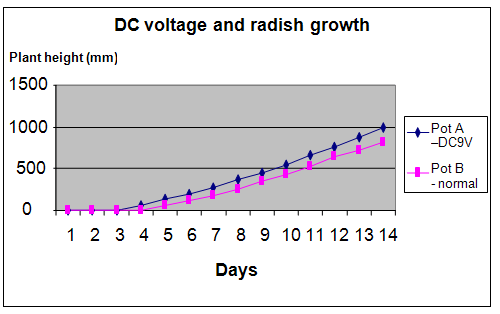
It  was observed that the average height of the radish plant in pot A which was given the electrical stimulation  was taller than the radish plants in pot B.

Condition

Average daily height of the radish plant (mm)

1

2

3

4

5

6

7

8

9

10

11

12

13

14

Pot A – DC9V

0

2

5

59

127

195

271

362

455

547

661

768

879

991

Pot B - normal

0

0

0

3

52

113

171

245

341

437

529

634

729

815

The graph below represents the results of our science project experiment:
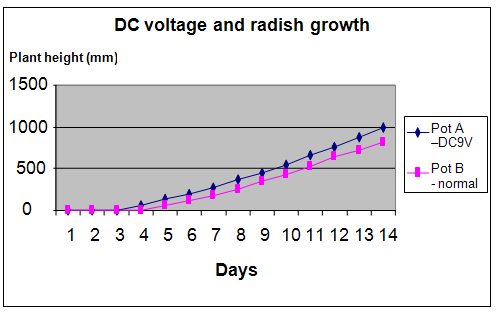
electricity and plants science project

Conclusion

The hypothesis that  radish seeds  induced with  DC electric voltages  will grow more quickly, is proven to be true.

Many electroculture experiments are being done in laboratories to show  that introducing an electric or magnetic field will enhance plant growth and seed germination. This method can be used in plant nurseries to improve the yield of plants being nurtured.

Also consider

Try to repeat the science project experiment by comparing the growth rate using different voltages like DC6V or DC12V.

The experiment can also be done by changing length of time of exposure to the DC current and comparing plant growth.

References

Electricity may play a role in plant growth - http://www.nytimes.com/1985/04/09/science/electricity-may-play-role-in-plant-growth.html

Electricity to induce plant growth - http://www.thehindu.com/thehindu/2000/03/30/stories/08300009.htm

What effect on plant metabolism and growth does electricity have? http://www.madsci.org/posts/archives/jun99/927642916.Bt.r.html

Related videos

These videos explain the science behind this project and demonstrate key concepts used in the experiment.
Share this Science Project:

Related Science Fair Project Ideas

Soybean Seed Mass and Emergence Speed
Sort soybean seeds by weight and test whether heavier or lighter seeds push through 10 centimeters of soil faster.
Medium
Soil-Borne Disease in Pea Plants
Plant pea seeds in 14 different soil samples and track which root diseases appear most often as the plants grow.
Medium
Vegetative Propagation Methods Compared
Clone a plant using leaf cuttings, stem cuttings, or layering and compare which method grows new roots first.
Medium