

Galileo's Inclined Plane and Acceleration
Hard
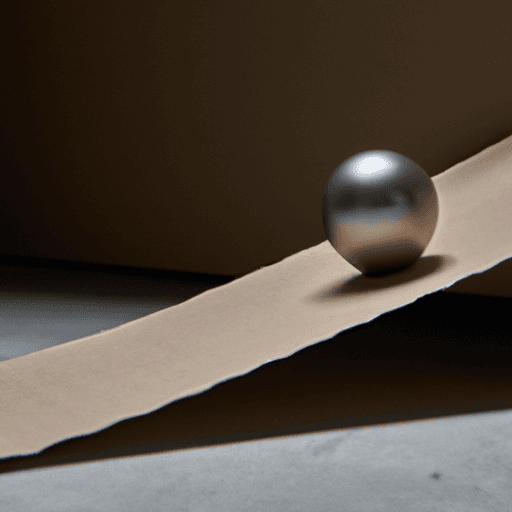
Can a ball rolling down a ramp prove that falling objects accelerate at a steady rate? Galileo claimed exactly this in 1638. He used a grooved wooden plank and a water clock to time a bronze ball.
You replicate his setup with a 16-foot grooved ramp made from two boards planed at 45 degrees. A steel ball bearing rolls down while a water clock measures each run. You mark the ramp at quarter and half lengths. Each distance gets 20 timed trials.
The result matches Galileo's claim. The ball covers one quarter of the ramp in half the total time. This proves acceleration, not constant speed.
Hypothesis
The hypothesis is that the ball will travel down one quarter of the plane in half the time it takes to traverse the entire plane.
Science Concepts Learned
Acceleration
Can a ball rolling down a ramp prove that falling objects speed up at a steady rate? Galileo claimed exactly this in 1638. You replicate his setup: a 16-foot grooved ramp made from two boards, with a steel ball bearing timed using a water clock. Mark the ramp at one-quarter and one-half its length, then run 20 timed trials at each point. The result matches Galileo’s claim — the ball covers one quarter of the ramp in half the total time it takes to traverse the entire plane. That’s not constant speed. The ball is speeding up steadily all the way down.
Method & Materials
You will construct an inclined plane using two 16-foot two by fours, sand and oil the groove to create a low-friction effect, and use a three-quarter inch steel ball bearing. You will also construct a water clock using a plastic bucket and plastic tubing.
You will need a piece of wooden moulding, a bronze ball, a water clock, two 16-foot two by fours, sandpaper, oil, a three-quarter inch steel ball bearing, a plastic bucket, and plastic tubing.
MEL Physics — hands-on physics experiment kits delivered monthly — real experiments, not just reading. (Affiliate link)
See what’s includedResults
The experiment proved that Galileo could have attained the accuracy which he claimed for this experiment. If the ball's velocity remained the same, it would travel halfway down the plane in half the time. However, the ball traveled down one quarter of the plane in half the time it took to traverse the entire plane, demonstrating the concept of acceleration.
Why do this project?
This science project is interesting and unique because it replicates a famous experiment from Galileo's time, and it demonstrates the concept of acceleration in a fun and easy way.
Also Consider
Experiment variations to consider include using different materials for the inclined plane, such as marble or metal, and using different materials for the ball, such as glass or rubber.
Full project details
Additional information and source material for this project are available below.Related video
These videos explain the science behind this project and demonstrate key concepts used in the experiment.
Get ready to be impressed because this video explains how Galileo, without the use of clocks or modern tools, was able to prove the concept of acceleration. You'll be amazed by the clarity of the explanation and how Galileo's experiment revolutionized our understanding of motion.
Share this Science Project:
Browse by Grade
Featured In
Related Science Fair Project Ideas

Build three wooden boats with different bow shapes and measure which one creates the least drag in flowing water.
Hard

Film trained athletes throwing javelins at six different angles to discover which release angle produces the longest throw.
Hard

Mount a bat on a stand and fire baseballs at it to test whether material matters without a batter.
Hard
Share this Science Project: