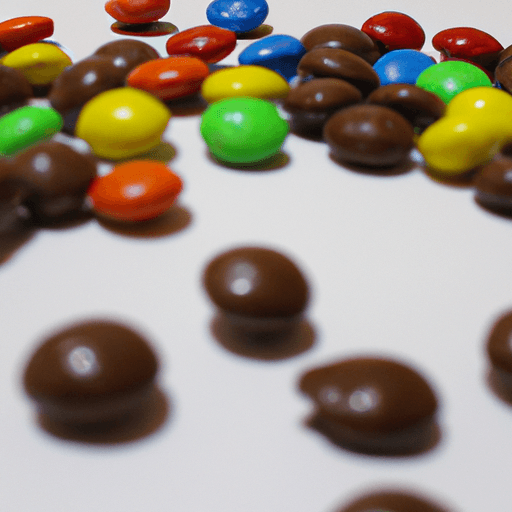
How many colors are hidden inside a single candy coating? The dye on a piece of candy looks like one solid color. But it may actually be a blend of several different inks.
You place a coated candy on a circle of filter paper or blotting paper. Then you drip water onto the candy one drop at a time. The water dissolves the coating and spreads outward through the paper. Different inks travel at different speeds through the wet paper.
After a few minutes, rings of separated color appear around the candy. Some candies reveal two or three hidden inks. Try several candy colors to see which one contains the most different dyes.
Hypothesis
The hypothesis is that the colors in the candy will separate out when water is added.
Put a candy on filter paper. Drip water on it drop by drop. The water pulls the dye outward through the paper. Each ink moves at its own speed. Soon you see rings of color around the candy. That is chromatography at work.
Water moves through tight spaces on its own. Place a coated candy on a circle of filter paper and drip water onto it one drop at a time. The water dissolves the coating and spreads outward through the paper, carrying different inks with it. Because each ink travels at a different speed, rings of separated color appear around the candy after a few minutes. Some candies reveal two or three hidden inks — try several colors to see which contains the most.
Method & Materials
You will cut a piece of filter paper into a circle, place a candy in the center, and add water to the candy. You can do this for each color of Skittles to see how many colors are actually inside each Skittle!
You will need filter paper, Skittles, a small cup of water, and a plate.
After a few minutes, you should be able to see rings of color around the candy. The colors that migrate the furthest from the candy have less of a mass than the ones closest to the candy.
Why do this project?
This science project is a fantastic way to introduce the concept of chromatography, while also providing a fun and engaging activity with colorful and delicious candies.
Also Consider
Experiment variations to consider include using different colors of candy, such as M&M's, and doing an experiment with dots of the candies' colors on a piece of filter paper, dangled above a cup of water (see video below).
Full project details
Additional information and source material for this project are available below.
These videos explain the science behind this project and demonstrate key concepts used in the experiment.
Did you know there's another way to uncover the secret colors of candies? By pulling out all the colors from the candies in one direction, you can compare all the different candies to each other and discover the rainbow of M&M colors like never before! This awesome video shows you how it's done, so get ready to become a candy color expert!