Search for Science Fair Projects

1000 Science Fair Projects with Complete Instructions

Bioethanol vs. Fossil Fuels: Energy and Burn Time

Bioethanol vs. Fossil Fuels: Energy and Burn Time

Hard
Share this Science Project:
This page contains full project details. For the summary, please see the Project Summary.

Science Fair Project Description

This science fair project was done to compare the performance of bioethanol against other types of fuel. The tests were done by comparing the energy produced, as well as the burning time of bioethanol, kerosene, diesel and gasoline.
Complexity level:7
Project cost ($):30
Time required:1 hour for preparation, 1 hour for experiment
Material availability:Easily available. However, access to a laboratory is required for this experiment
Safety concerns:

Hypothesis

Bioethanol has a lower energy density than gasoline. Hence, bioethanol will cause a smaller increase in water temperature when burned.

Overview

Biofuel

Biofuel is fuel that is obtained from biomass. Examples of biofuel are bioethanol, which is derived from the fermentation of plant material, as well as biodiesel, which is made from animal fat or vegetable oil. The use of biofuel is very popular in both the US and Brazil.
The most common biofuel in use today is bioethanol. It is a form of alcohol that is produced from the reaction of enzymes and microorganisms upon starch, sugar or cellulose. The sugar or starch used in the fermentation process is obtained from wheat, sugar cane, corn and other similar plants.

Bioethanol can be used to fuel cars. It can also be used as a substitute for gasoline, or mixed with gasoline. Usually, a 15% proportion of bioethanol is mixed together with gasoline, to be used as fuel in cars. Bioethanol has a lower energy density than gasoline. This means that a greater volume of bioethanol is required to produce the same amount of energy as gasoline. However, bioethanol has a higher octane rating, which indicates a higher level of thermal efficiency and better engine compression ratio.
 

Scientific Terms

Biofuel, biomass, bioethanol, enzyme, fermentation, microorganisms

Materials

The materials required for this science fair project:

-    200ml of bioethanol (biofuel)
-    200ml of kerosene
-    200ml of diesel
-    200ml of gasoline
-    1 lighter
-    Old newspapers
-    4 beakers
-    4 test tubes
-    1 test tube stand and holder
-    200ml of water
-    1 measuring cylinder
-    1 stopwatch
-    1 thermal mat
-    1 thermometer

Eureka Crateengineering & invention kits for ages 12+ — monthly projects that build real-world skills. (Affiliate link)

See whats included

Procedure

1.    For this science fair project, the independent variable is the type of fuel used – bioethanol, kerosene, diesel and gasoline. The dependent variables are the temperature rise of the water in the test tube, as well as the burning time of the fuel. This is determined by measuring the temperature of the water using a thermometer and measuring the burning time with a stopwatch. The constants (control variables) are the amount of water used, the amount of fuel used and the distance of the test tube containing the water from the burning fuel in the beaker.

2.    Using the measuring cylinder, measure and pour 200ml of bioethanol, kerosene, diesel and gasoline into each beaker. Label each beaker for its contents.

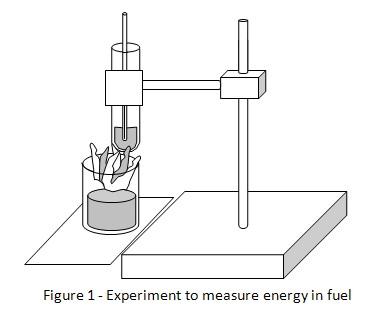
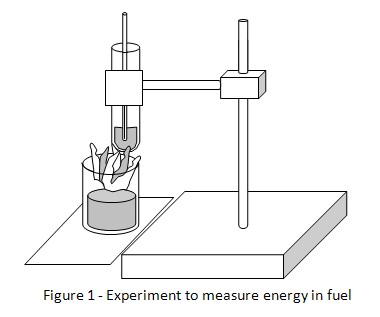
3.    Measure and pour 50ml of water into a test tube. Set up the test tube in a stand and holder, as shown below in Figure 1. Insert a thermometer into the test tube and record the starting temperature of the water.

4.    Place the beaker containing bioethanol on a thermal mat under the test tube, as shown below in Figure 1.

5.    Using rolled-up old newspaper and a lighter, ignite the bioethanol fuel and start the stopwatch immediately. Record the time taken for the fuel to burn out, as well as the highest temperature reached by the water, in a table as shown below.

6.    Repeat steps 3, 4, 5 and 6, substituting the bioethanol with kerosene, diesel and gasoline. Ensure that the distance between the bottom of the test tube and the center of the beaker remains constant for all 4 times the testing is performed.
 

bioethanol fuel science fair project

b1.jpg

Results

The results show that gasoline produced the biggest increase in the temperature of the water, while bioethanol showed the smallest rise in the water temperature. The diesel fuel burned for the longest period while the gasoline fuel burned out the fastest.
 

Fuel Type Bioethanol Kerosene Diesel Gasoline
Burning Time (seconds) 63 69 89 41
Temperature rise (° C) 36.5 44.5 42 46.5

Conclusion

The hypothesis that bioethanol has a lower energy density than gasoline, and therefore will cause a smaller increase in water temperature when burned, has been proven to be true.

The rising price of oil has increased the demand for biofuel as an alternative fuel. In 2008, about 1.8% of fuel used in transportation was sourced from biofuel. However, the increasing production of biofuel has raised concerns regarding the rising price of animal feed and livestock.
 

Also consider

The experiment may be repeated by using different types of biofuel, such as biodiesel.
 

References

Biofuel - http://en.wikipedia.org/wiki/Biofuel

Fuels - http://www.educationalelectronicsusa.com/c/fuels-VII.htm
 

Related videos

These videos explain the science behind this project and demonstrate key concepts used in the experiment.
Share this Science Project:

Related Science Fair Project Ideas

Wind Turbine Blade Angle and Voltage Output
Mount zinc-sheet blades at seven different angles on a DC motor and discover which angle produces the highest voltage from wind.
Hard
Wave Height, Frequency, and Power Output
Build a wave tank with a floating generator and discover how wave height and speed affect the voltage.
Hard
Forest, Farm, and Compost Soil Quality
Collect soil from a forest and two farmed fields to see how management changes its color and nutrient levels.
Hard