Search for Science Fair Projects

1000 Science Fair Projects with Complete Instructions

Bacteria Levels in Fresh, Frozen, and Irradiated Chicken

Bacteria Levels in Fresh, Frozen, and Irradiated Chicken

Medium
Share this Science Project:
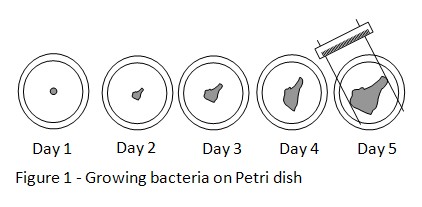
This page contains full project details. For the summary, please see the Project Summary.

Science Fair Project Description

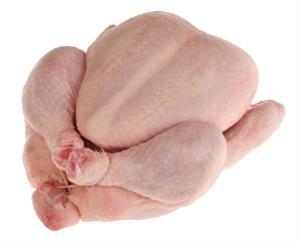
This science fair project aims to discover which type of processed poultry meat possesses the largest amount of bacteria. This experiment will be conducted using meat from a fresh chicken, irradiated chicken and frozen chicken
Complexity level:7
Project cost ($):30
Time required:1 day for preparation, 5 days for the science project experiment
Material availability:Access to laboratory equipment (eg. petri dishes)
Safety concerns:

Hypothesis

The irradiated chicken possesses the least amount of bacteria.
 

Overview

Bacteria in meat

Although most bacteria are harmless to humans, some of them are diseases=causing. Pathogens are bacteria that can cause illnesses. Food-borne illnesses occur when pathogens enter our food. Bacteria can be found in any kind of food but they  have a tendency to flourish in of protein rich foods like meat, poultry, eggs and dairy products.. The food that we purchase is usually already contaminated by bacteria, but this problem is easily solved by properly cooking our food.

Irradiation is another method of removing bacteria from our food, especially from meat products. This is done by bombarding the meat with either an electron beam or by gamma ray radiation. Irradiated food is thought to be safe to eat but there might be some changes in its taste, although many food activists disagree with this.
 

Scientific Terms

Bacteria, pathogens, food-borne diseases, irradiation, gamma rays

Materials

The materials required for this science fair project are:

-    3 agar Petri dishes
-    3 disinfected swabs
-    1 bottle of disinfected water
-    3 sterilized chopping boards
-    3 sterilized knives
-    1 piece of fresh chicken parts
-    1 piece of frozen chicken parts
-    1 piece of irradiated chicken parts
-    3 beakers
-    1 marker pen

Eureka Crateengineering & invention kits for ages 12+ — monthly projects that build real-world skills. (Affiliate link)

See whats included

Procedure

1.    The independent variable for this science fair project is the type of processed chicken meat – fresh, frozen and irradiated. The dependent variable is the size of the bacteria growth in the Petri dish. This is determined by measuring the size of the bacteria growth using a ruler. The constants (control variables) are room temperature, the amount of sunlight and the ingredients in the Petri dish agar.

2.    Prepare  3 Petri dishes  using agar and store them in a refrigerator. The Petri dishes are brought to room temperature before the start of experiment by taking them out of the refrigerator. Label the Petri dishes “Fresh”, “Frozen” and “Irradiated”.

3.    Label the 3 beakers as “Fresh”, “Frozen” and “Irradiated” as well. Using separate knives and chopping boards to prevent cross contamination, an equal portion of the fresh, frozen and irradiated chicken parts are cut and placed into the respective labeled beaker. Expose the outer surface of the  meat as this is where the bacteria will be found.

4.    Pour 100ml of disinfected water into each  beaker and soak the meat for 10 minutes.

5.    Wet the swab with sterilized water. Dip the swab inside the beaker. Swipe the swab over the respective agar surface according to the label on the beaker and Petri dish.  Close the cover and keep the Petri dish in a cool shaded place for the bacteria to grow.

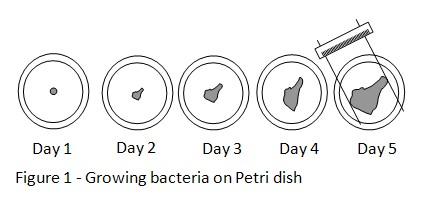
6.    Measure The diameter of the bacteria colony growth after 5 days and recorded it in the table provided below.
 

poultry science fair project

b1.jpgb2.jpg

Results

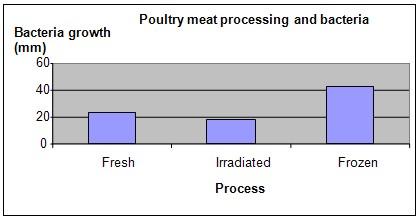
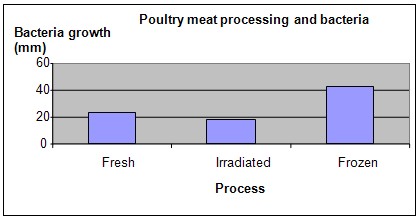
The results show that the irradiated poultry meat has the least amount of bacteria growing on it, followed by the fresh chicken meat. The frozen chicken has the highest amount of bacteria growth.


Processed poultry Fresh Irradiated Frozen
Bacteria growth (mm) 24 18 43

Plot your results on a graph as shown below.
chicken science fair project

Conclusion

The hypothesis that irradiated chicken has the least amount of bacteria growing on it is proven to be true.
 

Also consider

The science fair project can be repeated by varying the types of food/ parts of the meat that are tested for bacteria. Perhaps you could experiment with different methods of thawing meat, or evaluate whether the type of packaging used for the meat affects the bacteria count.
 

References

The truth about irradiated meat - http://www.mindfully.org/Food/2003/Irradiated-Meat-TruthAug03.htm

Bacteria that cause food borne illness - http://www.infoplease.com/ipa/A0762206.html

Related videos

These videos explain the science behind this project and demonstrate key concepts used in the experiment.
Share this Science Project:

Related Science Fair Project Ideas

Bacteria Carried by Common Insects
Let four insects walk across agar dishes and measure which one leaves behind the largest colony of bacteria after five days.
Medium
Bacteria Levels in Waterless vs. Water-Based Urinals
Swab five waterless and five water-based urinals, grow the bacteria in petri dishes, and measure which type produces larger colonies.
Medium
Wet vs. Dry Food and Bacteria Pickup
Drop cucumber slices and cheese crackers on four different surfaces, then count the bacteria colonies to see which food type picks up more germs.
Medium